Sunset at Thunder Cove

Never think Japanese Poetry doesn’t get you anywhere…I offer proof that it can offer glorious unexpected gifts.


If I hadn’t been a Japanese-form poet I would not be part of a most amazing family: Haiku Canada, with sisters, brothers, and cousins one with the aim of writing the best of Japanese forms.

Deep connections allow for the most elegant challenges available in any poetry, along with all the help one needs to learn to write it and/or enjoy it.

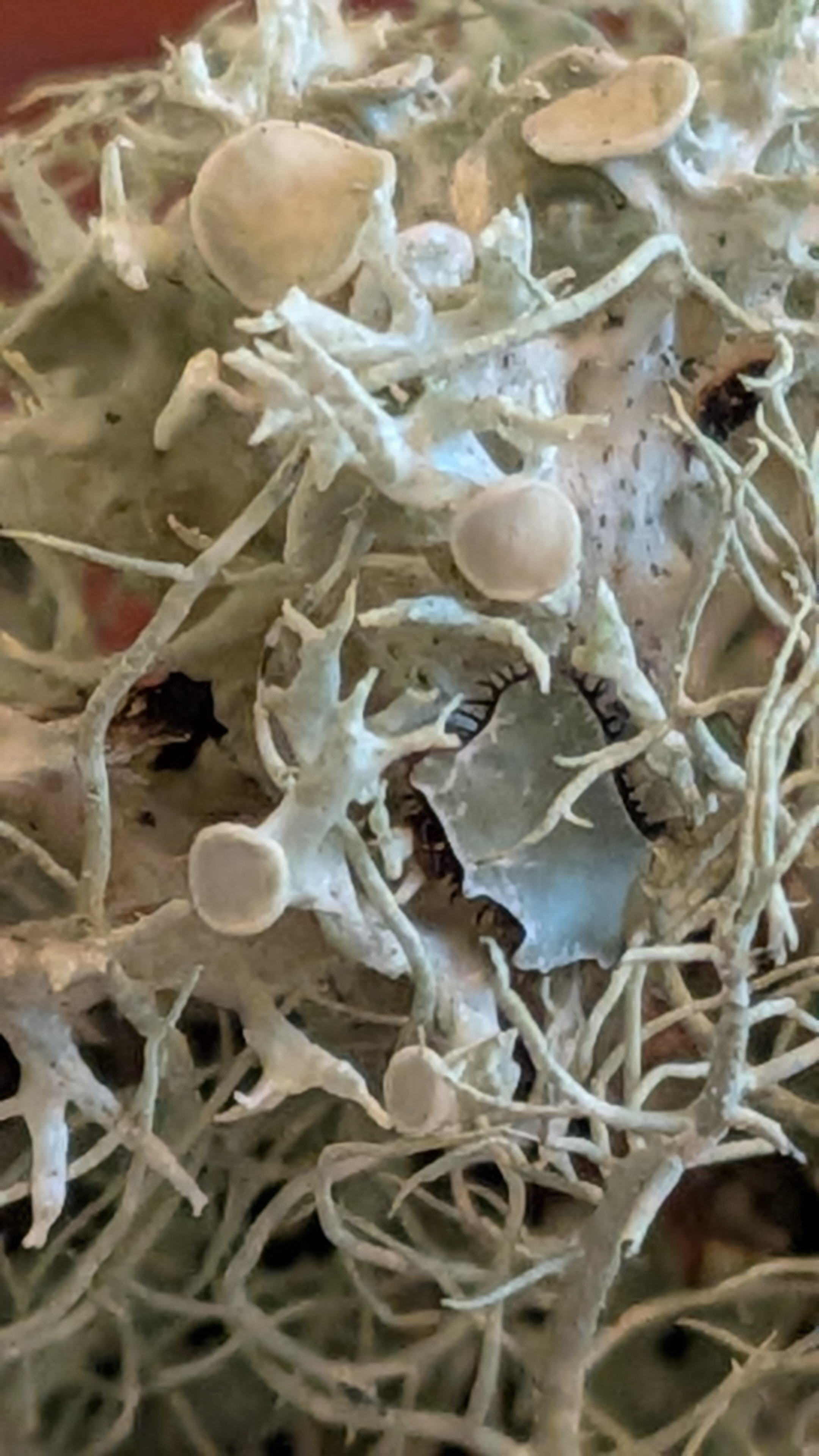
It’s like Graphis scripta, the lichen that is like the secret writing of trees. You have to know about it. Getting to know Haiku Canada people, well, it’s the best secret ever, but one we love to share.

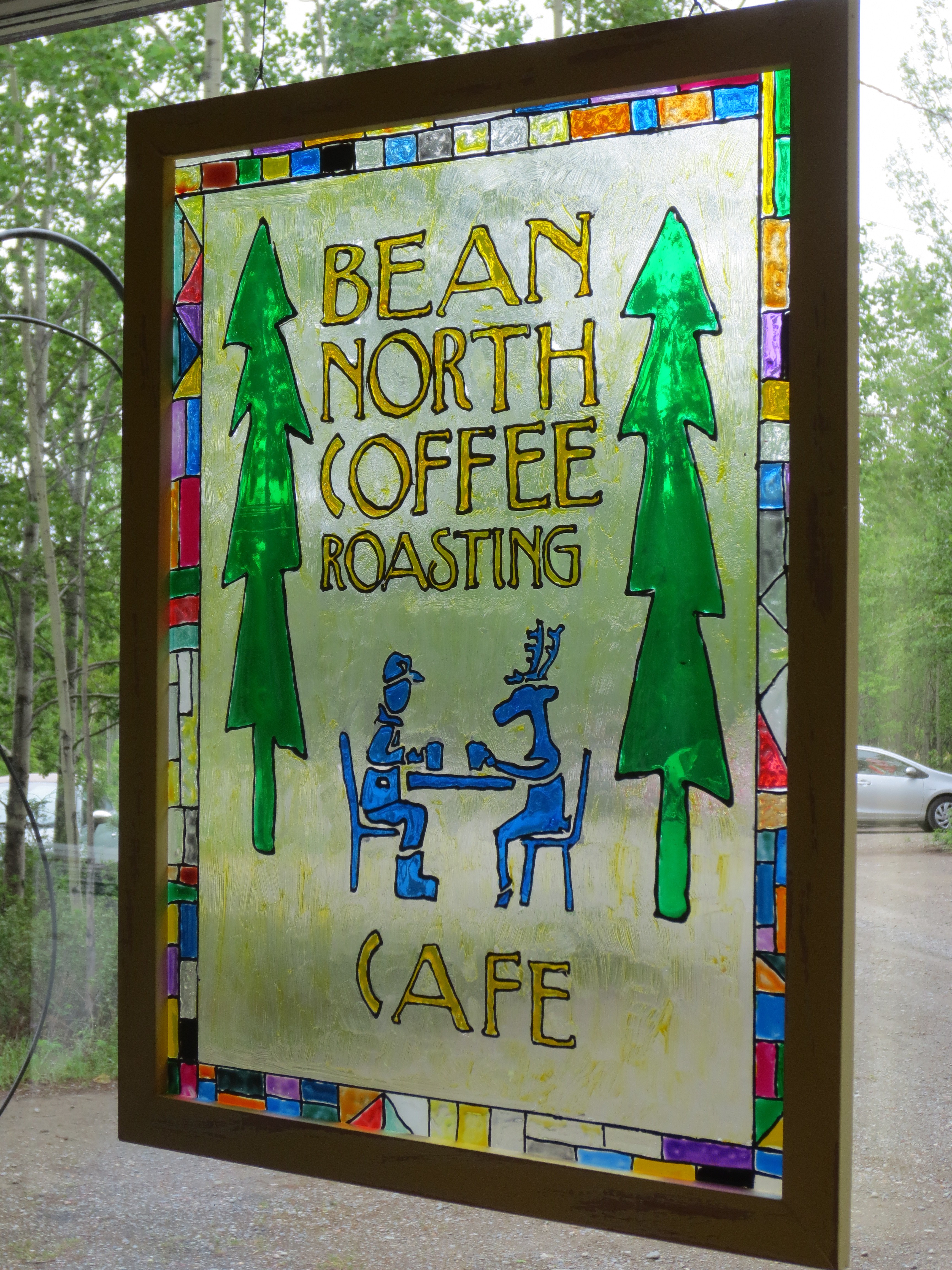
Things happen to make this happen. Every year there is a ‘conference’ held somewhere in Canada, and everyone is invited. But this current year has offered even more opportunities to experience, learn, and/or share these forms. It’s like having access to magic. The coffee, for instance, was magical when some of us met afterwards at Yukon’s Bean North.
Haiku Canada this year was in Lennoxville, Quebec, at Bishop’s University. The presentations were interesting even to long-time poets. For personal reasons, I left early, so I won’t say much about it here, but I would say that you should come to the next one which will be held in Kingston, Ontario. I’ll add a tag to this post.

This year further invitations were extended to join a Maritime Haiku Getaway at St. Stephen’s University in St. Stephen, New Brunswick, and to a Haiku Day in Charlottetown, Prince Edward Island. I was grieving but the best place for me at this time would be with my poetry family. With poets, you mean? Not only poets, I say, but haiku poets.

Mike Montreuil and I would fly to Saint John, rent a car, drive to St. Stephen, planning to drive on to Prince Edward Island for the second event.

Some of us got there early. We just had to go to the local diner, Carman’s. Loved the juke box on the table and the billboard at the parking lot. The food was pretty good and the service wonderful!


At the University there would be some planned presentations but most of us went into the weekend with open minds as we know that events involving Japanese forms are always stimulating no matter what happens. Participants ranged from long-experienced poets to newer writers. We were offered choices of zeroing in on haiku, tanka or haibun. It gave us the chance to go deeper into a form, spend three or four hours on it, or move around to check out a different form.
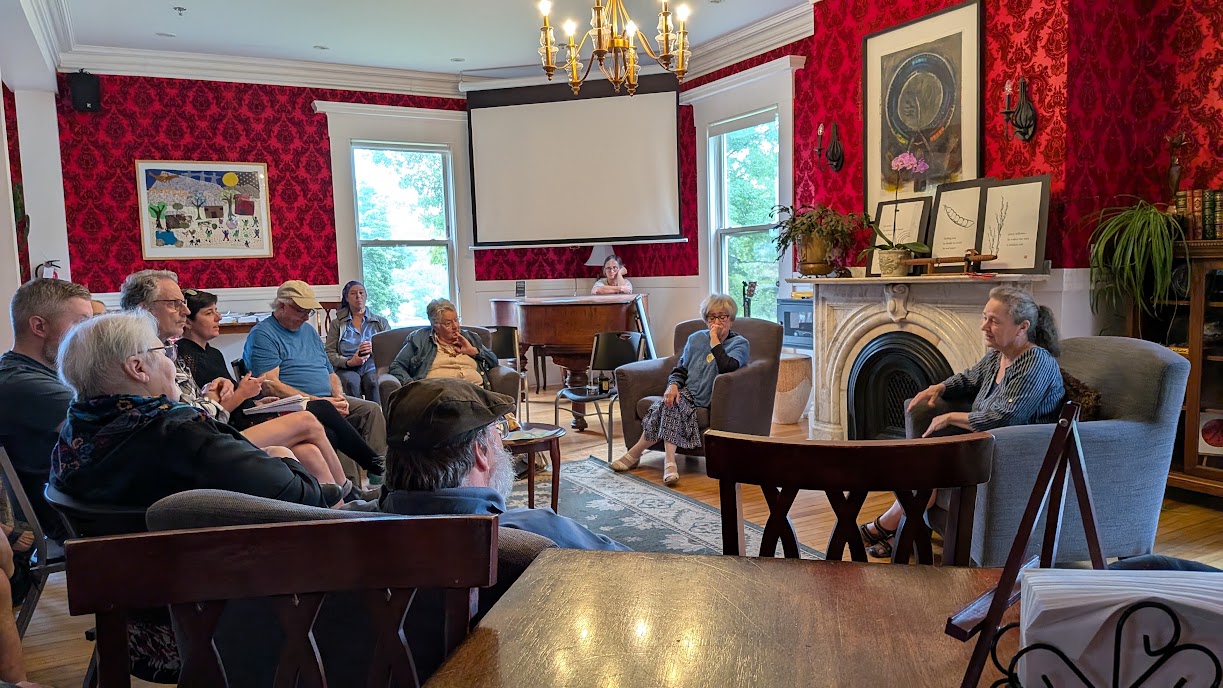
The building itself was so beautiful to work in, and the town so beautiful for casual roaming as well as for a gingko walk. A dynamic presentation by Angela on haiga, a combination of haiku and Art, encouraged us all to try it.

Some of our best poets and organizers were also the best cooks, dishwashers, and servers as this particular weekend was a communal affair, with lots of time for getting to know the other participants, whether over a meal, or hanging out in one of several comfortable nooks. So What if the stove took an hour to cook pasta, So What if I had to wing my presentation because I’d left the PowerPoint file at home. We laughed a lot and discovered each other.
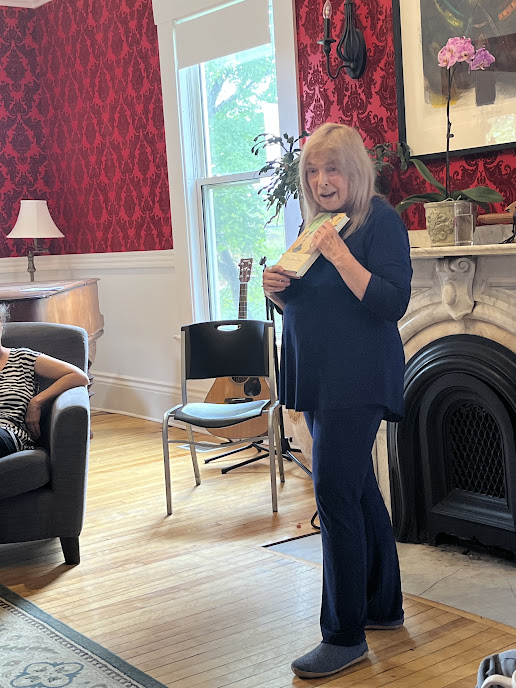
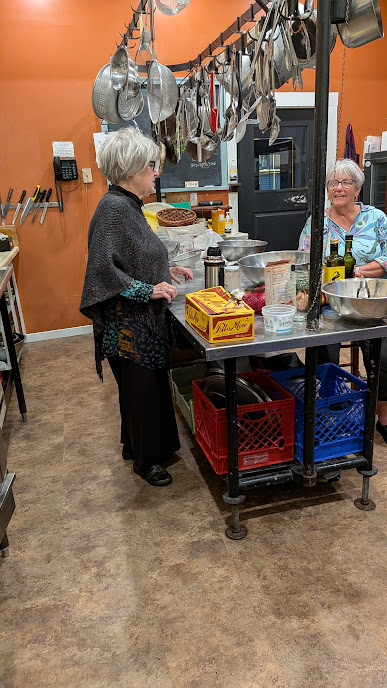
haiku poets at lunch/ an enthusiastic discussion/ of Winnie the Pooh

A few of us let down our hair after hours, joining Hans, with guitar, Rob, Sandra, Brendan, and others with flute, drum and tambourine, to belt out hilarious renditions of songs like Ob la Di Ob La Da.


Mike and I then drove through the autumn beauty of Southern New Brunswick, stopping by the water at Grand Manan.

Mike, and some Xanthoria parietina on the rocks at Grand Manan.

We crossed the Confederation Bridge to Prince Edward Island. It was nostalgic for Mike as he’d worked on that construction. Nostalgic for me as I was last there crossing on a ferry more than fifty years ago with my little boy.

This is where the ‘coming close to Nirvana’ kicks in. Nancy and Peter Richards hosted Angela, Caroline and Carole in their home and offered me and Mike a chance to stay in their cottage at Thunder Cove.

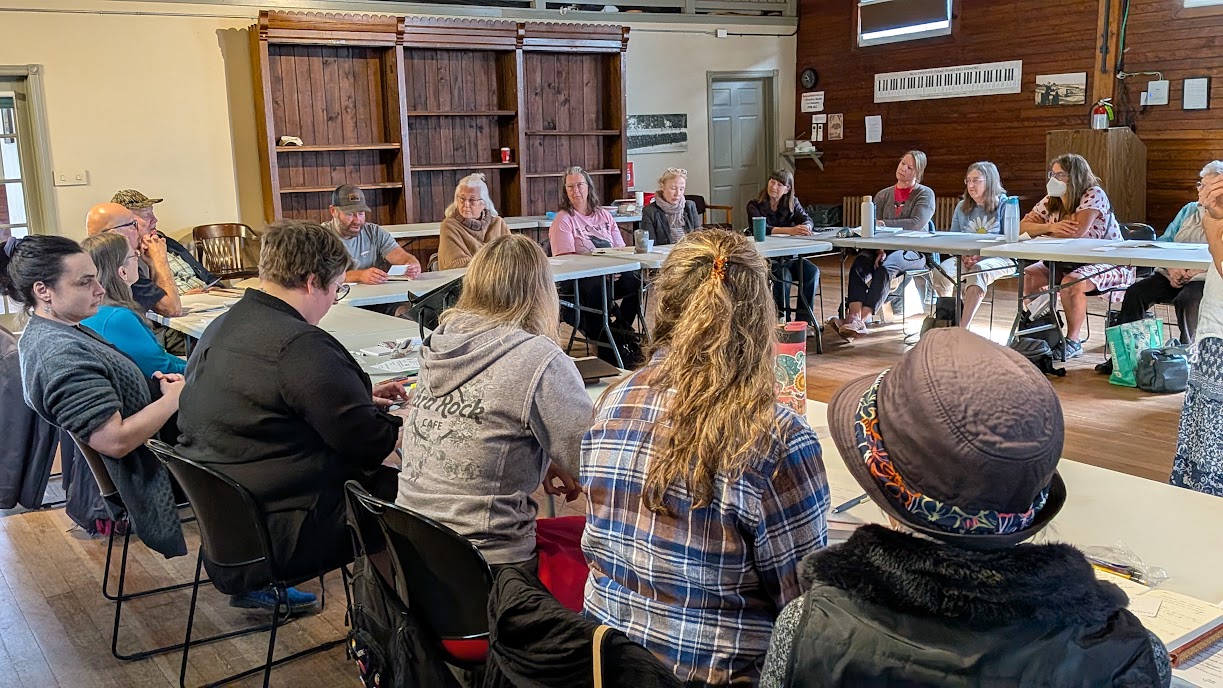
They had collaborated with Angela, Caroline, Carole, Mike and me to present haiku for a day to mostly new writers of the genre. As the only two known haiku poets in the province, Nancy and Peter had organized space at the historical Coach House in Charlottetown, another beautiful building. Expecting a few participants, they had to keep adding tables and chairs as early on, the room started to fill up with people INTERESTED IN HAIKU! Sessions on haiku, haibun and tan-renga were presented. It seems these poets plan future meetings in person or on Zoom. A Win-Win situation!
You see, this is the kind of unexpected gift, the Nirvana that Japanese poetry might offer! Thunder Cove was a magic place, the beach long and red with only a few people exploring it. Mike worked a lot on The Haiku Canada Review; we both wrote for hours. I spent hours on the beach in all kinds of weather, even before and after sunrise, and at sunset. 

Sunrise and sunset and lichens (Ramaline dilacerata) …there’s nothing more to ask.

From this post you may gather that I am interested in lichens. The identifications may not be perfect. But lichens are similar to the organisers mentioned throughout this post, the participants of these two events, and the haiku world of poetry itself: perfect jewels that continue to surprise with gifts.  

A Reading in Montreal

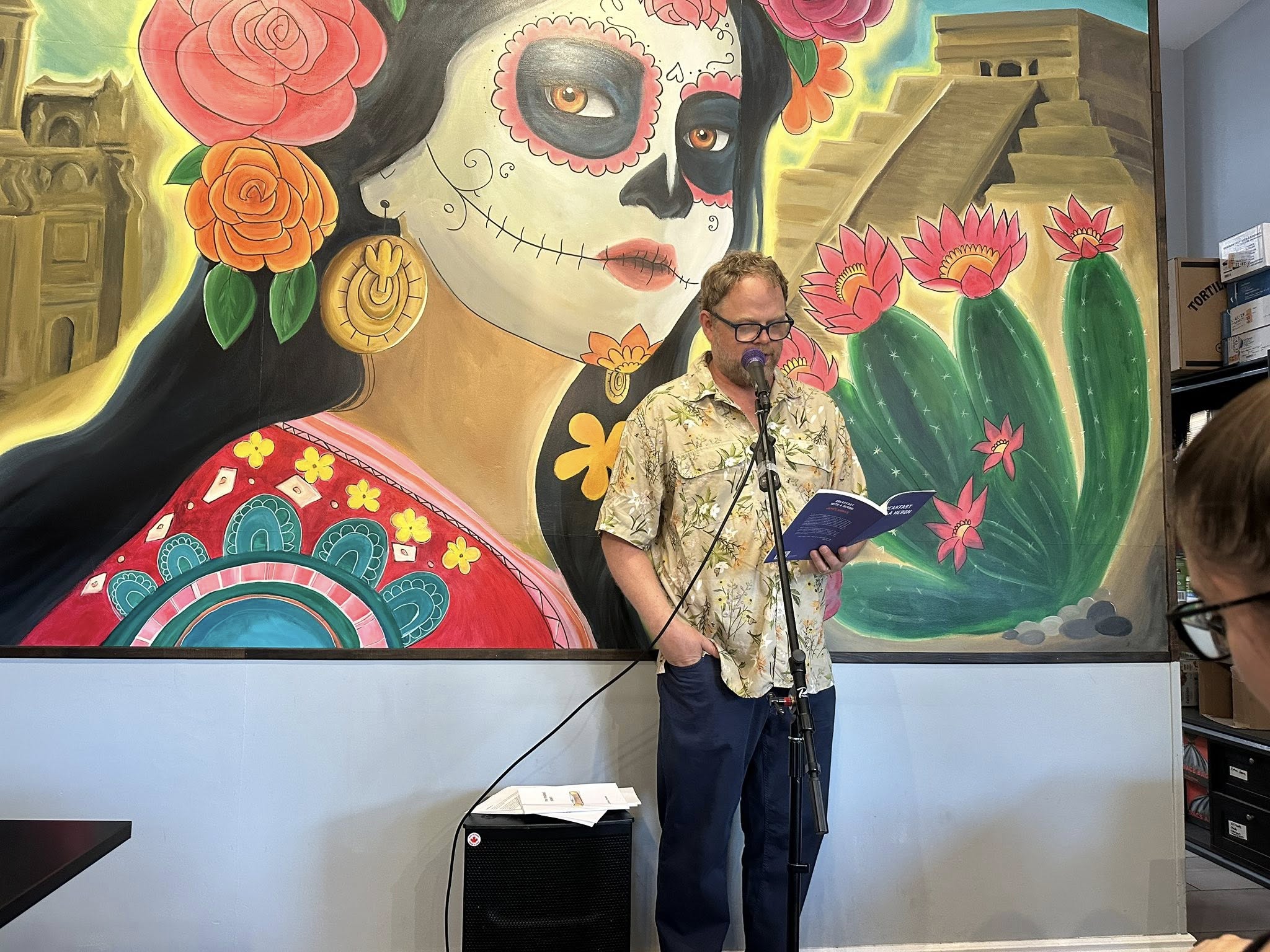
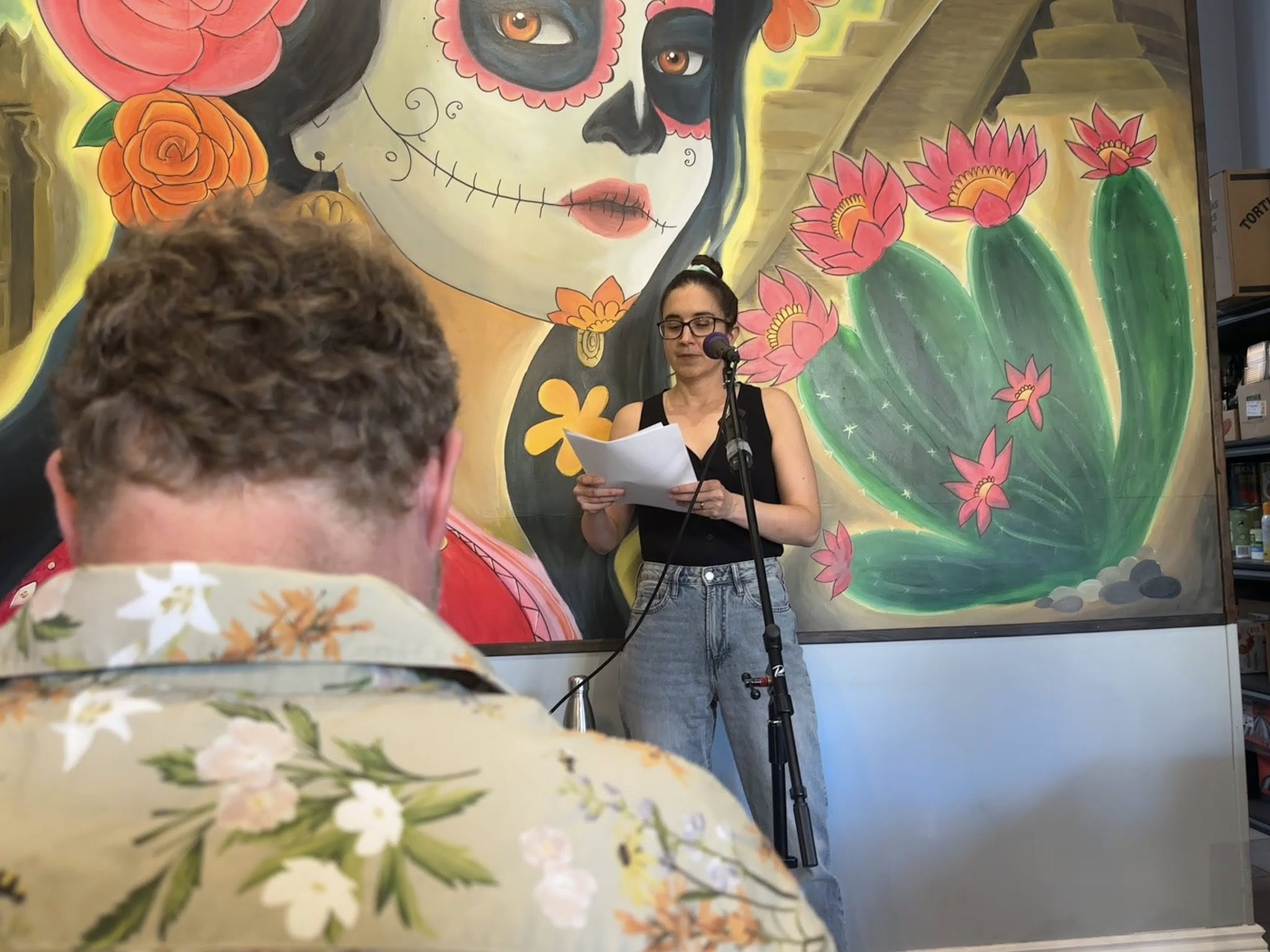
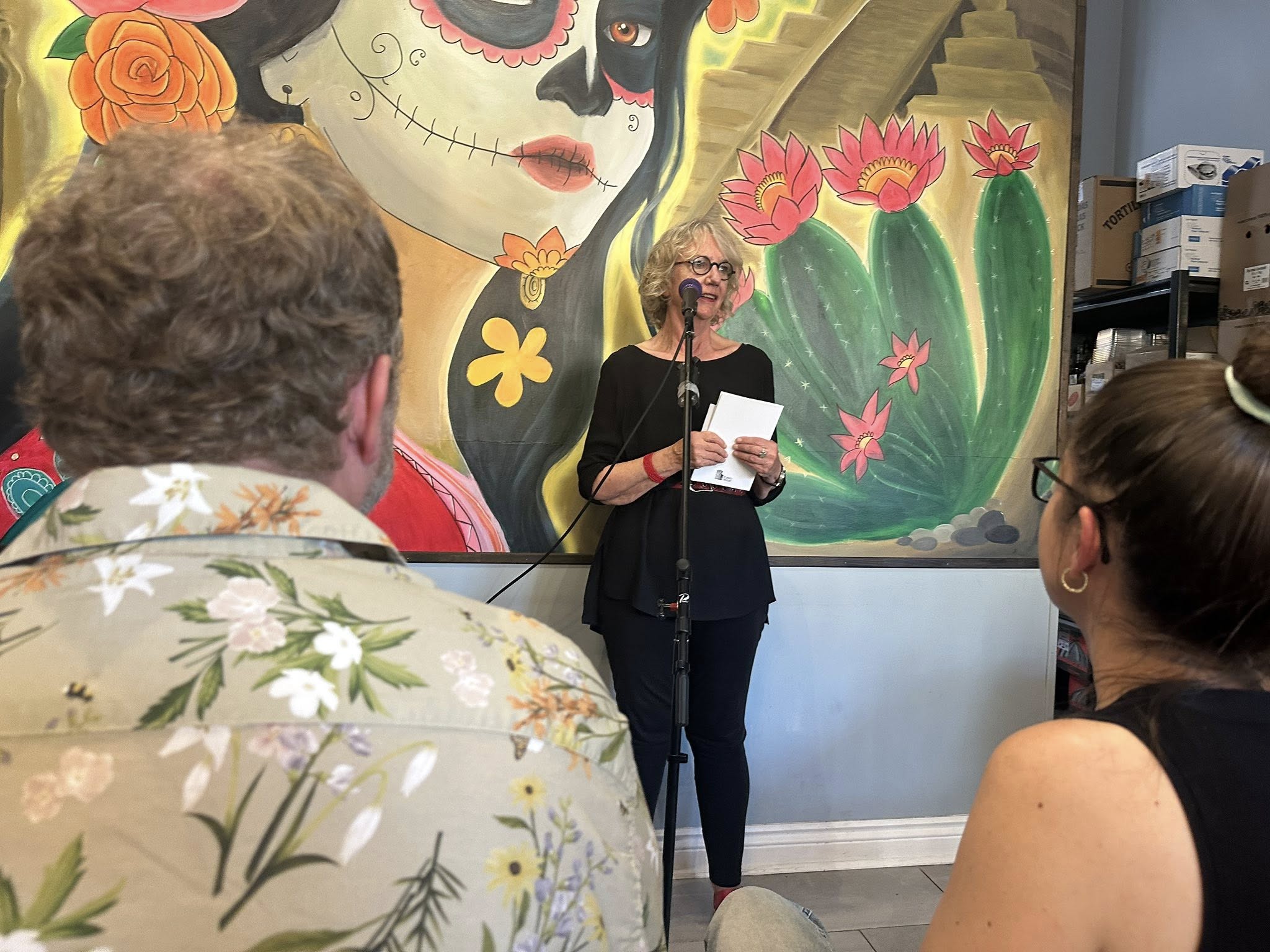
Look at this terrific mural at Café 92 degrés on rue Sherbrooke in Montreal! It was the setting for a reading on August 14th. This post has been a long time coming, as life tends to get in the way. Since then I’ve been at the Maritime Haiku Getaway in St. Stephen’s, NB, and a Haiku Workshop in Charlottetown, PEI.

More on those in the next post.

But the four of us poets who were lucky enough to read together Café 92 degrés on rue Sherbrooke in Montreal can warm ourselves with the memory of our Turret House Press reading on August 14th. I was late. It had been many years since I last faced traffic in Montreal at rush hour. Let that be a lesson if I am ever fortunate enough to be at this café again for any reason. And there are many.

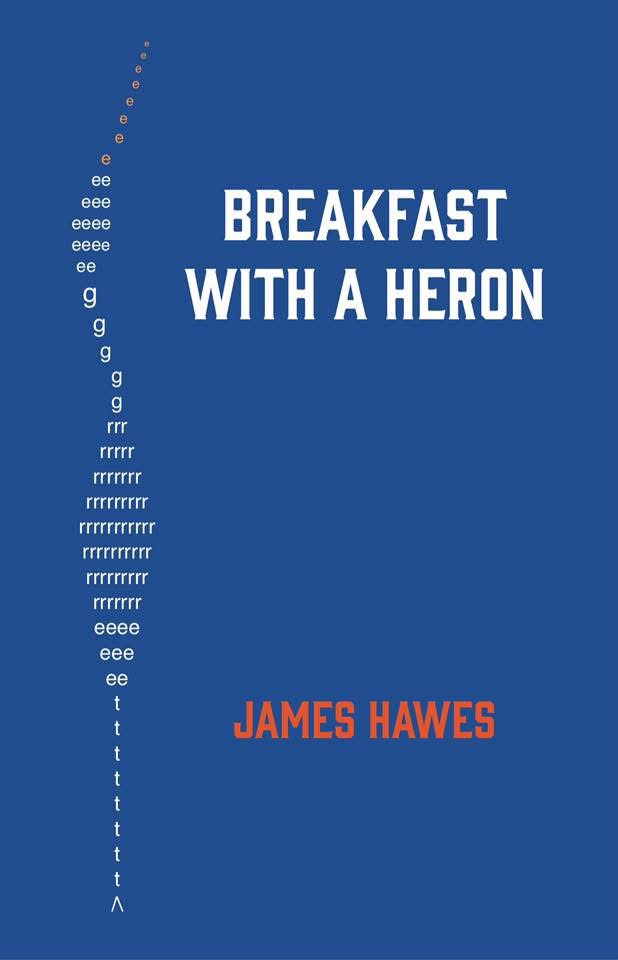
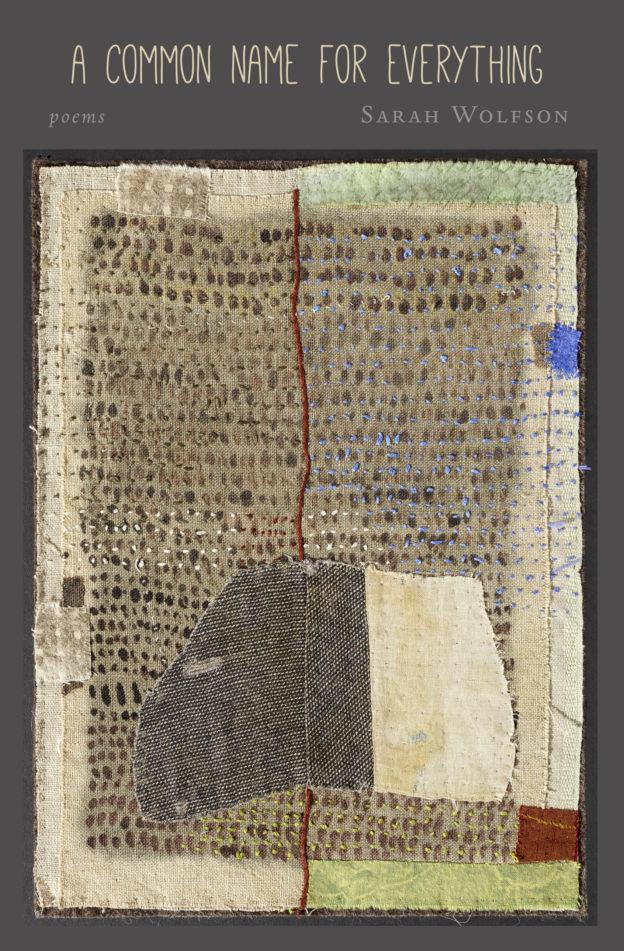
The reading was part of NDG Arts Week, which made me wish I lived in that area as so many cultural events were happening. Four of us read that night. The audience graciously and vigorously applauded poems by Cora Siré, Sarah Wolfson, James Hawes and me from these collections:

Well I am not lying when I say how excited I was to be part of this reading. I regret being late. I would have enjoyed more conversation with people who were in the room. I enjoyed talking with Sarah’s son, and the excitement when a woman came up with a photo on her camera of a bee heavy with pollen just after I’d read about bees sonicating. One of the best parts of the evening was meeting the poets I read with. I’d love to talk about their poetry with them. They seemed to have forgiven me for being so late and stayed afterwards for what I hope was the start of longer conversations. On anything.

My niece Jessica had just been to her first reading and enjoyed the experience. Perhaps I’ve discovered another poetry lover in the family. That would be wonderful. We all waved from the patio in front of Café 92 degrés as James took off on his shiny red moped. He claimed it was his company ‘car’.

Without a place to stay and be fed, I wouldn’t have been able to make the reading at all. Lynn and her poet husband Marco Fraticelli are champions for putting up with me, for putting up with hours of traffic that evening.

Hosts Lynn and Marco had bought several portions of Tres Leches cake at the cafe! None of us had ever tasted it. A treat for after hours of traffic! On the way back to Pointe Claire Marco tossed something over his shoulder to where I was sitting behind him, something I’ve treasured ever since: a black cap from the Café 92 degrés with its logo. The cap and I have travelled to New Brunswick and Prince Edward Island since then; I wear it every day.

I shout out a huge ‘thank you’ to everyone who came that night, such an attentive audience of poetry lovers. Thank you James Hawes, and the Café 92 degrés people who were such gracious hosts. Thank you city councillor Peter McQueen for your comments afterward, and, though I’ve never met you, thank you Olivia Domingues Johnson and Notre Dames des Arts for organizing the evening.
The Tres Leches cake was amazing. I’d return to the Café 92 degrés just for that!!!

How I would love to do it all again.

They are here!!! They are here!!!

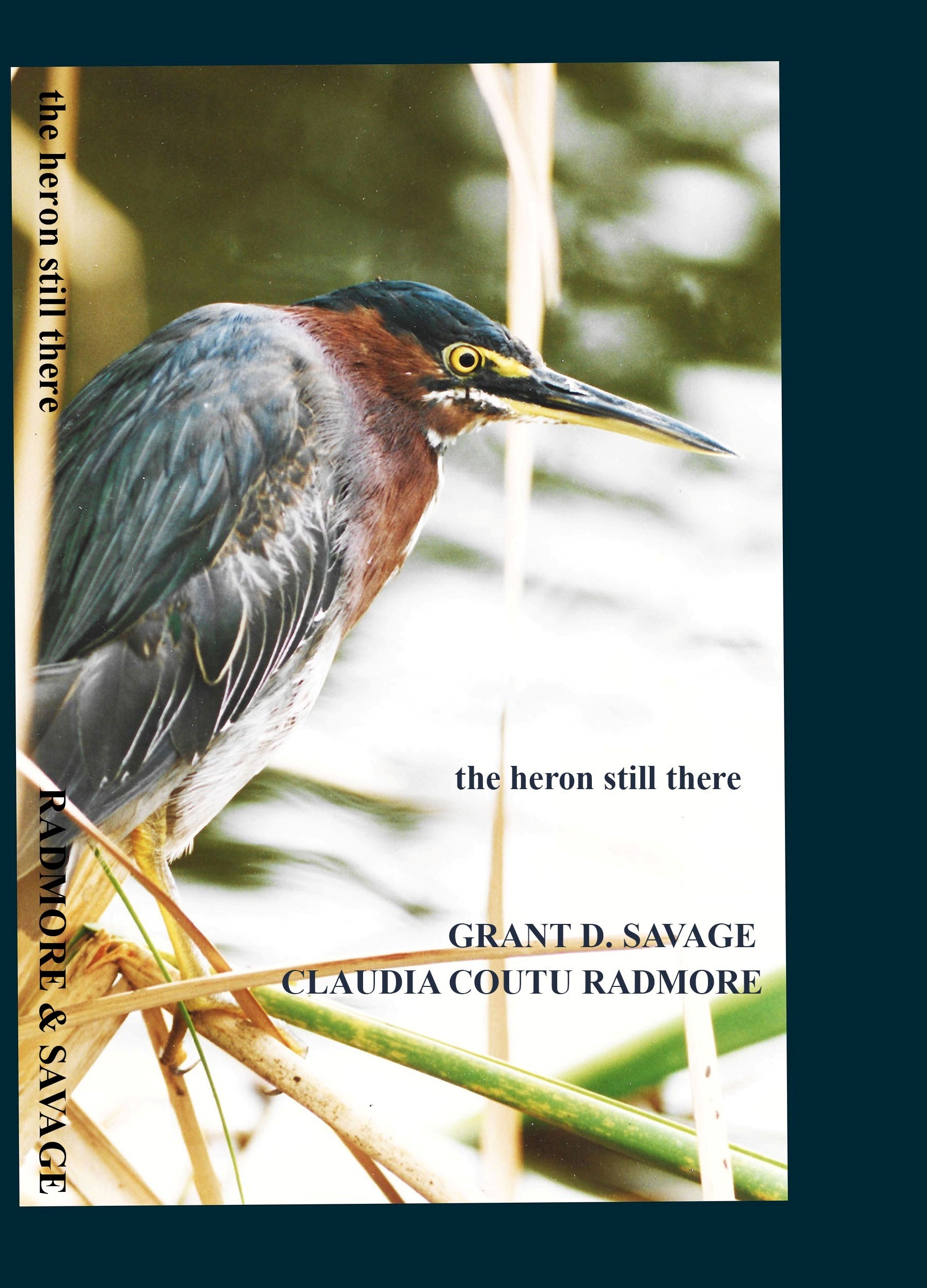
You’d think by now, a new book out would not be exciting! But this time there are two books just out! Sweet Vinegars: Wildflower poems (Shoreline Press, Montreal) and the heron still there, with Grant D. Savage, 500 tan renga poems linked. (Éditions des petits nuages, Ottawa)

To quote from a cover blurb by Greg Santos, “… this mighty collection blooms with playful, surprising, thoughful, and magical observations.” Thank you so much Greg. I’m chuffed to have this from a poet I so admire.

I am so pleased that John Rayner of Carleton Place let me use his photograph of Butomus umbellatus, Flowering rush bareroot, for the cover! When I saw it on Facebook years ago, I hoped that the poems would one day be published with this cover.

From a blurb by Susan Gillis, “Playful or sombre, sometimes both―and more― the poems (like bees after pollen) go to the heart of what it is to be human now, in a world where so much is at stake.” Thank you, Susan, for these treasured words.

The other collection, the heron still there, comes from a year-long collaboration with the fine Ottawa haiku poet Grant D. Savage. (Cover photo by Grant!) Its publisher, Éditions des petits nuages, is one of Canada’s leading Japanese-form poetry publishers. Grant and I are so fortunate that Mike Montreuil took on this unusual collection. Thank you Mike!

These are linked tan renga (short linked) poems, and I am so in awe of Grant’s great all-round knowledge and erudition. I never knew what kind of link would happen as it could come from his Science, Math, literature, or poetry (and more) background. The idea of the tan renga is to add a verse that is linked to the previous one, but which veers in a different direction. It was so much fun, and a super challenge to write tan renga with him.

The form requires attention from a reader as there is a ‘game’ aspect in figuring out what the links are, and where the next verse is going. There are many allusions (mostly noted at the end of the collection), and many fun lines, always unexpected.

I hope readers enjoy all aspects of either/both collection(s). Sweet Vinegars is available through Shoreline Press, but also from me at claudiaradmore@gmail.com.

Trees Listen: In Memory of Lesley Strutt and with thanks to Diana Beresford-Kruger and Frank Horvat

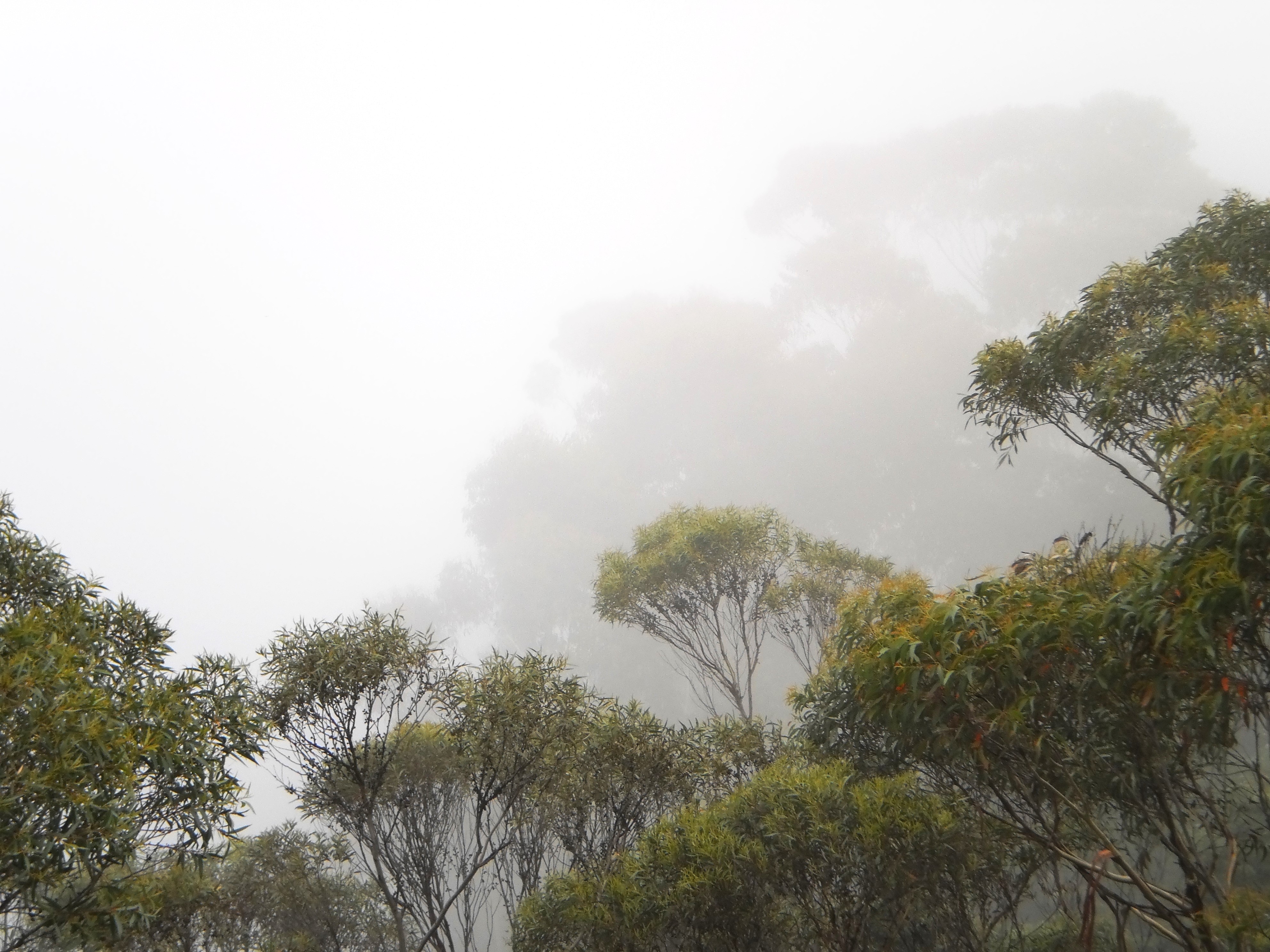
In the Blue Mountains

On Sunday I heard a beautiful piece ( I wrote ‘peace’ by mistake, but it would have suited this album well) on CBC’s In Concert called ‘Pine’ from an album called Trees.listen by Frank Horvat (with Sharlene Wallace). It is based on writings by Diana Beresford-Koeger, the latest of which I am currently reading.

This is where to find this remarkable music: https://frankhorvat.com/discography/trees-listen/

The book is Our Green Heart, The Soul and Science of Forests. I have to order my own copy, as the library will want this copy back, and I don’t want to give it up. I’ve ordered Trees.listen on CD which is just out and I should be getting my copy very soon. I’ll sort of bunk down beside my mailbox until it arrives.

In 2018 Lesley Strutt edited Heartwood: Poems for the Love of Trees for The League of Canadian Poets. The foreword was written by Diana Beresford-Kroeger. They shared a love of trees. Leslie always encourage(d)(s) donations to https://treesisters.org

Thank you Frank, for your music. Thank you Diana Beresford Kroeger for your life work and writing. Thank you Leslie.

a year and more away from my blog

It’s not that it’s been a terrible year, in fact we’ve had the joy of a new grandchild, Callan, not yet two months old.

But there have been deaths, and sadness as well. Writing has taken a lower place on the ladder of life, but just for a while. I am proud to have published books and chapbooks with my Catkin Press, though fewer than usual.

‘Dérive’, by Marco Fraticelli is the French translation of his best selling ‘Drifting’, haibun based on the journals of Celesta Taylor, woman of many merits from the Eastern Townships of Quebec, whose story is unique and all encompassing. Copies of either are available from Marco. (marcofraticelli.com) (He’s also the author of ‘Dear Elsa’, another run-away best seller! ( The best introduction to haiku I know. It’s step-by-step clear, in a touching pen-pal correspondence between fifth graders, which will have you aching with laughter) (Red Deer Press | 2023/ $14.95. Available through Red Deer Press , or your favourite bookseller. His email is on his website.)

The next beautiful book, ‘Stone Garden,’ by Rich and Zo Schnell recounts the transformation of their garden into a spiritual place. As the second part of the title suggests, it is a place of meditation and poetry, with the work of many poets who write in Japanese forms. Truly beautiful in every way. Available at richschnell73@outlook.com

I asked Pearl Pirie if she had haiku lying around as I would like to do a chapbook, and of course, she did. This collection, so sensitive to her world, invites you in, and somehow you find yourself just settling in with the poems.

And Susan Atkinson was running out of copies of her haibun collection, ‘The Birthday Party: The Mariachi Player and The Tourist’, but asked for an edited version with her alternate choice of cover colour. It was ready for her to read from at the Manx, so many other fortunate people got copies.

I have been writing, writing, and meeting most weeks with the Ruby Tuesday poetry group. We have lost a dear member this year. I think of Jacqueline (Bourque) often. We miss her very much for many reasons, not least her poetry. Her posthumous collection will be coming out with McGill-Queen’s University Press, which made her very happy. She knew joy to the last.

I have been writing, though I can’t prove it as yet. My own book of wildflower poems, ‘Sweet Vinegars’ will be published in Devon, UK, in 2024, and editor Susan Gillis has been wonderful as I plow through the manuscript for ‘The House on Fanning Lane’. But I have been slow to send the second part. It’s all my fault.

Admitting this next project in a public blog will make it happen: a collection of haibun called ‘Désirée/ Life, Laughter, Loss’, (working title). It is written, in pencil, something I haven’t done for a while, and I hope I can read my writing in order to dictate it into Word. It was written day by day after my lovely little parrot died. It will be the third collection after ‘Désirée/ nude in sunlight’ and ‘Désirée/ air bone feather’. How much joy this gorgeous little lorikeet gave me and Ted over the past 23 years! (Is still giving us…)

I have also lost Cynthia French as a dear Poet friend in Nova Scotia. She was, with Les, a magnificent host, but more to the point, a lover of words who put them into poems I like to keep by my bed. ‘Remedy’ is a collection and a work of art ‘within and without’ to use the words of George Harrison, as it is printed on papers handmade by her daughter, Nancy French, (lindenleapapers.com).

I have been writing. I have. Keep checking this blog and please hold me to account.

I wish all of you a tremendous 2024 with a muchness of joy and creativity to help get through the harder bits.

À la prochaine…

Enough of being lazy

It’s about time I wrote about what I am up to in this writing life. Today I joined eight other poets to celebrate the Ruby Tuesday Writing Group’s 16th anniversary. What an incredible group of women to work with every Tuesday morning. It’s been the engine that has driven all of us to publish often in journals, chapbooks, anthologies and full collections.

But this is an all-about-me day, for if George Harrison can write a memoir called I Me Mine, then I can post this one blog in memory of his. (More about George later…)

During the pandemic, my collections rabbit (Aeolus House Press, Toronto) and Park Ex Girl: Life with Gasometer (Shoreline Press, Montreal) were published, which gave me time to work on several other things. A collection of poems about the wild lives of wildflowers is the hands of The Longmarsh Press in Devon, UK, whose editor loves the poems and wants to ‘do something with them’.

Aeolus House Press, 2020

So I have been busy, and still am. This winter I’ll put my energies into editing a book-length poem about designing and building my old-lady house more than twenty years ago. So you see, this why there’s all this hurry to get things published. Now I am a lot older, and my time on this mortal coil is getting shorter and shorter. I’m not upset about it; I’m more upset about the state of the world I will be leaving. Meanwhile, there’s still the life of writing, the life inherent in a writing life.

So I finally finished a collection I’ve been working on for years called Pink Hibiscus: Poems of the South Pacific. I was a CUSO volunteer in Vanuatu from 1986 until 1989, and returned for three months in 1993. It’s a challenge to write memoir as poetry. The inclination is to try to tell everything, so that poems become stories rather than poems. With the help of three writing groups and several editors, the stories did become poems, and now they have arrived in a lovely publication by Éditions des petits nuages, an Ottawa small press run by Mike Montreuil, who publishes Japanese-form poetry as well as lyric collections in French and English.

The main title comes from a particular poem, but the subtitle is a reference to James Michener’s Tales of the South Pacific, because Michener wrote that book while stationed in Vanuatu during WWII. It was then known as the New Hebrides. Not many people know about the island of Bali Hai, but I have been there. He spied the island while writing in the officers’ mess on the island of Santo. He knew it was really the island of Ambae, where all the beautiful young women had been sent in order to protect them from the American soldiers (true!). And he never went to it, fearing to be disappointed. As all writers know, mystery can be important, and he never wanted to see anything different from what was in his imagination.

I, on the other hand, have been to Bali Hai (Ambae) several times, staying in my students’ villages, explaining to the villagers and the chiefs, in the language of Bislama, why the village should build a preschool, and why they should pay a teacher for it. The language of Bislama?

In a country of roughly 110 distinct languages, a common language was necessary, and originated with white colonizers’ need to communicate with the original peoples whom they hired as workers or used as slaves. It is a pidjin language, and I learned it in order to teach and to speak all over the country and even on the radio. Then I wrote ( I was Claudia Brown at the time…) a teacher’s manual in the same language. (Terry Crowley made sure my written Bislama would be easily understood.) The manual showed teachers how to teach preschool concepts and run a preschool without money on an island without, sometimes, even basic amenities.

I spent time on about 15 of Vanuatu’s 80+ islands, traveling in small planes, over pathetic dirt roads in rusty land Rovers, in aluminum runabouts and dugout canoes over shark-infested waters, and took photos at night, from its rim, of the fires inside a volcano. You can get a copy of Pink Hibiscus or any of the books mentioned earlier by messaging me.

My plans are to concentrate on the long poem about my old-lady-house-building experience, continue a non-fiction account of the Vanuatu experience to go along with the poems, and oh, I am having so much fun with the ‘George’ poems.

Being a much too intense Catholic teacher in the 60s and 70s, and being a good Catholic wife and mother, I missed the whole Beatles experience. Wasn’t everyone told that pop music was the Devil’s creation, meant to lure young peoples’ souls?

But now, I have the chance to discover a beautiful musician, (I’m not too old not to realize how physically beautiful he was) and am entranced with his life, with his music, and with his life philosophy. He, now, was a beautiful soul, and may still be one. I’m not speaking from a religious point of view, but even the Catholics would have approved. George and I were born within weeks of each other, both of us had fathers who drove for a living, we both owned Cooper mini-cars, we both married the same year. I’m impressed with so many of his songs, with his sense of humour, his generous spirit, and the fact that he made only the movies he wanted to make. I am also impressed with how he handled his life pressures. True, drugs were part of his life and certainly not part of mine, that he was a genius musician and I know nothing about music, but even this late in the game, I can discover some of what I missed all those years ago. And, like him, I feel that life is just this little play that is going on. And, yes, another ‘and’, I am having a whale of a time writing my ‘George’ poems.

Sharing Neverendingstory

Today is not my writing; I am shamelessly sharing a post ( as we are asked to do in his post) from a wonderful blog on haiku and tanka called Neverendingstory, and its approach to changing how those forms are being written today. Thank you to Chen-ou Liu and Angela Leuck. You will always thank me for encouraging you to follow the Neverendingstory blog. It will be a brief beautiful moment in your day.

The handmade paper calla lilies in the header and these delightful wind-up toys from a market in Santa Fe, New Mexico, have little to do with this post. They are here to hopefully catch your eye, and merrily suggest that you read on…

Cool Announcement: Celebrate Tanka Poetry Month with NeverEnding Story
Posted: 01 May 2021 09:16 PM PDT                     
Poetry acts as a witness in, to, and most importantly, through troubled times.
                     Chen-ou Liu, An Interview with Dimitar Anakiev

My Dear Friends:
Please join NeverEnding Story to expand the readership base for tanka by tweeting at least one tanka a day throughout the month of May. The hashtags for Tanka Poetry Month are #MayTanka and #NaTankaMo.

on the windowsill
two canaries singing
to each otherI
tweet and retweet
NeverEnding Story

Below is excerpted from Angela Leuck’s article, titled “Tanka and the Literary Mainstream: Are we ‘there’ yet?” (“Book Review Editor’s Message,” Ribbons, 10:1, Winter 2014, p. 74):

An alternative approach is suggested by Chen-ou Liu, author of the blog, “NeverEnding Story.” In his June 2012 Lynx interview with Jane Reichhold, Liu describes the current relationship between the haiku/tanka community and the literary mainstream in terms of “an asymmetric power relationship.” He believes a “top down” approach will not work; i.e., trying to change the perceptions of those in the mainstream. Rather, Liu supports a “bottom up” approach, which for him means consolidating and expanding the readership base for tanka through online publishing and social networking sites. He argues:

If there are more people who love reading/writing haiku and tanka, the mainstream poetry world will eventually open their main gate to haiku and tanka poets. This approach to reversing the asymmetric power relationship has been demonstrated in the case of the power transfer from traditional media, such as news papers, TV, and books, to online and social media.

Please help spread the word about this celebration via your poetry blogs, websites, Facebook pages, and Twitter accounts. And NeverEnding Story seeks tanka submissions

To conclude today’s “Celebrate Tanka Poetry Month” post, share with you my interview excerpt and tanka selected for the upcoming Bulgarian-English Tanka Handbook written by NeverEnding Story contributor, Dimitar Anakiev
Red Moon Press’s tanka 2020: poems from today’s world gives me a glimpse of what is possible when efforts are made to challenge the poets to write something new and relevant to the world we live in.  Poetry acts as a witness in, to, and most importantly, through troubled times. That’s what this book does.


Here are five of my tanka for the handbook:

a winter fog
smothers the winding road
to her mother’s house
the bruises on her face
say everything & nothing

bits of gravel
embedded in blood
on his knuckles
my teenage son says nothing
and I’ll do … nothing

a wind
rattling the dry leaves
on eucalypti —
an ink-dark trace
of koalas

unshackled 
from my childhood beliefs
I’m a passing
thought in the mind of God
who forsook his Son on the Cross

we’reallinthistogether           
snow             
on           
snow 
onhomelessshelter


Happy Reading and Writing throughout the month of May

Chen-ou

As to those calla lilies…

paper calla lilies

in the market

screaming with colour

how they seduce me

like an audacious Santa Fe lover

As to those wind-up toys…

hundreds of wind-up toys

in a Santa Fe market

what temptation to break

the tenth commandment

I coveted all of them

a girl and a gasometer: storytelling in poetry

Uluru,  sacred Aboriginal place, Australia

The facts of a life, the remembering of that life, affirming its importance, is a challenge biographers and autobiographers have taken up for thousands of years. Australian Aborigines saved their cultures and survived under the harshest conditions because of storytelling, their storytelling in song, precursor to poetry as we think of it today. Even the Odyssey was possibly a way to map the Mediterranean, the journey compressed into poetry, because to tell every thought and emotion and fact along the way would have been too long for a culture to remember and pass down.

Beaumont Gasometer, photo thanks to the Carinci family. Just over the cap on the boy on the right, in the distance, you can barely see the top of the building where I lived.

Therefore, poetry, to capture in a shorter literature, using poetic form to aid in the compression of fact and emotion, was the best way to tell my story of a girl and a gasometer and how it was integral to the growth of a neighbourhood.

Because that doesn’t sound too interesting, does it. The gasometer has passed from the modern world, along with the memory of it and the way commerce, urban society, and eventually rural society depended upon finding ways to store an aethereal commodity so it could light, warm, and feed communal populations before electricity was economically and technically available. What about the processes that made it possible?

Fakenham Gasworks Museum, UK. Retort oven to be filled by hand with coal.

Shoveling coal into twenty or thirty of these retorts a day, the oven heat up to 3000 degrees.

From Genii of the Lamp, an essay by Charles Dickens, in 1862:

The manufacture of gas, although it

includes many beautiful

scientific processes, is not, on the

whole, a sightly operation. What is

not seen may be refined and

interesting; but what is seen decidedly

savours of pandemonium.

There are huge caverns of red hot

coke, and a row of fiery ovens,

which sooty men are constantly

feeding with coal thrust in, out of

large iron scoops.

So then, I chose to use poetic techniques to tell the whole story effectively, to use drama, memoir, repetition. Capture the sound of a part of history in thirty lines, repeat for emphasis, connect the past to emotions one can relate to in the present day. Bring back childhood, make the past, what has been lost, real.

four years old

so tired

breathing is such hard work

there are two doors in my room

one to enter the room and one

to the verandah

a window in the door is divided

into four squares and the squares

are filled with gold

is it heaven?

my mother tells me

it is a gas tank

1945, my cousin Joanne on the far left, me on the far right, with children from the Campbell families. Photo from Billy Rosser.

And tell the story so that it can be absorbed in hours. Do it through words that can lodge in the brain, rather than flash on a screen for minutes, and easily forgotten.

Corner of McGill and Notre dame, 1914

…was it

your grandfather who came to do this whose tough

European build dug this trench dug miles of it

no steel-cap boots no compensation just stay ahead

ten hours a day to dig a trench for miles of gas pipes

a solid trench a reliable wood plank shoring wall

on a good day a good man shifts three tons of dirt

I wanted to emphasize how the lives and work of those before us were as important as anything people do today, and that without them, today would not exist. This is the work narrative poetry does.

Read this excerpt, preferable aloud…(there are 15 more lines of processes in which steam was important, in order to have clean gas reach the gasometer). Hear the rhythm of how steam once caused our world to go round…

steam for clearing chemical obstructions in pipes

steam for clearing naphthalene in pipes

steam for clearing tar in pipes

steam for preventing congealing in chemical tanks

steam for preventing congealing in chemical wells

steam for general cleaning of equipment

steam for heating cold buildings in the works

steam for maintaining the temperature of process piping

steam for preventing freezing of the water under the gasholder

steam to ensure high-quality secondary combustion

steam as a reactant in the carbureted water gas plant

steam to drive the equipment thereof…

I hope you will, with me, feel the loss of childhood, everything that was my, and your, world:

I wasn’t there when they took down the gas holder

I can’t image how that huge bell was dismantled

though I sometimes see its miles of rounded rivets

in my dreams like cloth buttons fastening the great

curved metal sheets together and how they turned

smartly at the corners of each panel two by two

double rows catching the sun like a marching drill

that we learned at school; could I have handled

the dismantling or the empty gasometer exoskeleton

bereft and without purpose like someone unexpectedly

not able to find their way home from the supermarket.

Johnny Ashton’s milk wagon and and his horse, with two of the Campbell children. The photo shows the concrete base of the gasometer, containing the water that ‘floated’ the metal gas holder. The picture was taken in front of where I lived. (permission of Corpusse Ashton)

My childhood neighbourhood is gone, and yet it lives on, because of poetry.

To obtain a copy of Park Ex Girl: Life with Gasometer, send an e-transfer for $25 to claudiaradmore@gmail.com, (address and name in message) or send a check to her at: 49 McArthur Ave, Carleton Place, On, K7C 2W1

The Rigors of Writing a Narrative Poem

It’s the easy kind, right? Tell a story and break it into poetic lines. Go back to it with the old saws, add interior rhyme, see if you can emphasize rhythm, at least in part of it. Take out articles, adverbs and extra adjectives. See if you can fit a metaphor in there, a morale, perhaps, a relevant line from someone else’s poem. Make it more political. Quote something that sounds preternaturally wise.

And so forth, which is like trying to turn a plastic kayak into a schooner by adding a particular kind of sail. Both shapes float, after all. It’s a difficult thing to do, but I find it hard to pull it off.

There are no right and wrong ways to do it, but perhaps going ‘slow’ is a good suggestion. On the other hand, going ‘fast’, letting it all out in one blast, can work too.

Elisabeth Bishop said it took her twenty years to write ‘The Moose’, which meanders lyrically, establishing the Atlantic setting geographically and psychologically, taking a while to get to the actual moose. It’s clear that she has a lot to say about many things, and that while the moose has been roaming around in her mind for many years, the passengers on the bus, the clinging, dense, claustrophobic feel of the woods and a subtle atmosphere of menace are integral to the main point of how the curious power of nature can transform a rather ordinary moment into a transcendent one.

All to say that spending time with a first draft is a step forward for me. I decide what form I will use, what poetic form. It helps me to determine right away that I am writing a poem, and not a story, not only a story. Giving my narrative a definite poetic is important to me helps even if I change it later. I decide on a short or the long line, on the kind of punctuation I will use.

My long poem rabbit (rabbit, Aeolus House, 2020), happened because a rabbit died. With zillions of rabbits in the world, that death should not have been momentous, but I needed to write the poem. It wouldn’t take long to tell. The rabbit came to our yard. It was hurt and it died.

I knew there was more to the story but not why. Here’s where writing habits kick in, such as the benefit of writing on and on, like a marathon, stream-of-conciousness, and continuing even if nothing seems to make sense. Eventually something will kick in and say Enough, time to edit and look for a pattern or a path. Amazing things sometimes happen if I stick with it.

But poems can get bogged down in trying to make sense, trying to dig deeper, trying to be more poetic. The key word is ‘trying’. The opportunity to free my mind from any constraints, (maybe wine would have helped) was there when I wrote ‘rabbit’. I needed to plod on, because I thought I had more to say that was connected, the way that everything is connected. It was time to play, and grab whatever came along in the wind.

Eventually the synapses decided to connect and linked this particular sorrow, one that seemed out of proportion with all the other sorrows in the world, to those lurking somewhere inside of me. One sadness instantly brought back many previous and concurrent ones.

In this case what the poem was after was loss, eventually zeroing in on the Notre Dame Cathedral fire in Paris, where I had sat to listen to an organ concert by a famous Canadian organist. How I worried during the fire about the thousands of organ pipes I’d heard in glorious song! Loss lingered on the severe illness of one of my dearest friends, and the possibility of losing her.

I write a lot of narrative poems. At present I am working on a series called WILD Wild Flowers & friends, about plants that I met on local trails in the summer. I say met, because the encounters seemed entirely personal, as if I’d met some of them before. Of course, I had. In years past I had even tried to remember the names of some of the flowers, nearly all of which to all I felt about meeting that wild plant. I’d forgotten. Once I identified a flower on a trail, I focussed on it, research on the internet, tied information gathered, reclaimed our acquaintance.

So I had a few ways into a poem. I had, for example, the water lily’s Latin name, Nymphea odoratus. Already I had nymphs, and odors to think about, and my reactions to both while further research uncovered amazing facts about this ubiquitous lily. I had tonnes of material, and I still wanted to write a short narrative poem. It’s easy to get carried away in narratives by enthusiasm.

Here’s where the value of The Ruby Tuesdays, an Ottawa writing group, kicks in. I had so much botanical information in the first water lily draft that the wonder of the lily itself was eclipsed. I had allusions to great Art, and to Greek mythology. I had the whole kitchen in it. But it didn’t have a heart yet.

It helped to ask for the opinions of other poets I trusted; my family and friends might like what I’ve written but are prejudiced, sometimes against. A botanist might be over the moon to see an abundance of her specialised language in my poem, but if I wanted valued advice, I needed the point of view of poets. Meeting on Zoom, I read the poem aloud, and started to realize some of my problems. I listened to comments and took them seriously, whether I agreed with them or not.  It’s such a great group, there’s no need to be defensive.The Rubies said cut the scientific jargon down, along with editing the cracks, crevices and alcoves I’d included, on rhythm, and gave advice on syntax, cadence and word choice.

I had written a terrible draft, and needed underscoring of where I’d gone wrong, because it is so hard to throw out my favourite words, even if the only reason I liked them was for the sound of the scientific vocabulary.

I have trouble making a group of words, of lines, into a poem that I’m satisfied with. I always want my poem to take wings, and am disappointed that I often don’t know enough, haven’t read enough, haven’t spent time enough thinking and rewriting. It’s hard when a narrative I care about crashes like a kite in a storm.

Writing a good narrative poem is just as hard as writing a good ghazal or sonnet. I think of trees. The final narrative is the tree, but it exists because of its roots and the mycorrhizal interplay underground. Without fungus, the tree might be lost. The more healthy the underground inter-reliance, the healthier the tree. I do believe though, that the more free associating and cutting I do, often makes for a better poem.

The tendency is to lapse into free verse, which again, seems easiest, but isn’t. It depends on what the writer wants: a story or a poem. If a poem, why not make it a good poem.

poem as slick made thing: from Alice in Wonderland to Yehuda Amichai

A line comes to mind, an image, a quote, a throwaway comment, an intriguing word, and a poet realizes a poem has to come out of it. At least that an attempt must be made. What the poem will be, its shape and content, even its theme, might be unknown. The poem starts to be made, another line, a word follows, coming as if out of the air.  If I have an idea for a poem and know where it is going, I might as well forget it. My interest is gone.

This isn’t how all poems are made, but it’s an interesting way to work. Underneath all the thinking and making, a poem may end up being about something deep in the subconscious, something important that has been waiting for a platform.

But since a poem is a made thing, it can be approached in many ways, the way a child looks at the materials available and without thinking, begins to make or build. We grow out of it; as adults simple playing can be embarrassing. Adult play sometimes narrows to games of one sort or another.

The poem at the start of the rabbit collection, ‘where language forms’ had several beginnings. I’ve written poetry for many years in the Japanese forms of haiku and tanka, among others. In three or five small lines, the poet often is conscious of using juxtaposition, of not following a thought in what many would consider a logical way. Something magical can happen by having a reader or listener make their own leap between two written concepts.

Another ‘brick’ in the building of this poem is my collection of pretty well anything that comes to my attention, via book, facebook, conversation, television or radio, basically I’m like the bird that collects things becaus they are blue or shiny. I collect words in various arrangements.

When I started writing lyric poems like this, it confused me. How do such disparate sets of words seem to work for me. They didn’t seem to work for some in a critique group. But some juxtapositions took hold ‘in my gut’, and insisted on staying together.

In this case, the poem started with the second verse, a quote from Lewis Carroll, and when it came to continuing the adventure, I decided to play and find lines that were noteworthy, colourful, or lines that I wanted to read over and over. Well, I’d think, let’s put that into a poem, see if I’m still interested in what I’m making.

It reminds me of Mary Dalton’s Hooking: A Book of Centos, and being astounded how lines from other poet’s work fit together because the poems ask readers to use their own intelligence and sensitivity to make meaning from a poem. Because I wanted to make my own leaps, and my own meaning.

So it was that ‘a hint of the philosophy behind the southern drawl/ sweet and delicious as falling into butterscotch’ from the mystery writer Barbara D’Amato, was so delicious and buttery that it need something to ‘stop the story’ because ‘the lens of our mother tongue changes it’, a quote from Czeslaw Milosz.

In the same way, singer/songwriter Adam Lambert’s ‘broken pieces break into me’, is true to Shakespeare’s ‘this our life, exempt from public haunt’.

The critical point is when all the pieces are in the right position, and the maker realizes what the poem may be about, discovers a central meaningful idea. Here the flexibility of language, the freedom of it, how curious it can be, how what a biologist with expertise in parrot-ology has to say is of  equal merit to that of a well known poet or philosopher, how the one expression can deepen the richness of another all spoke of shadows, memories, the everyday realities we live with.

The first two lines are mine and they came after the rest of the building blocks had rearranged themselves into a comfortable room in this language house.  As ‘poem’ comes from the Greek poíēma, meaning a ‘thing made,’ and a poet defined in ancient terms as ‘a maker of things’ it’s comforting for me to remember that a poem is a strange thing which operates as nothing else in the world does.

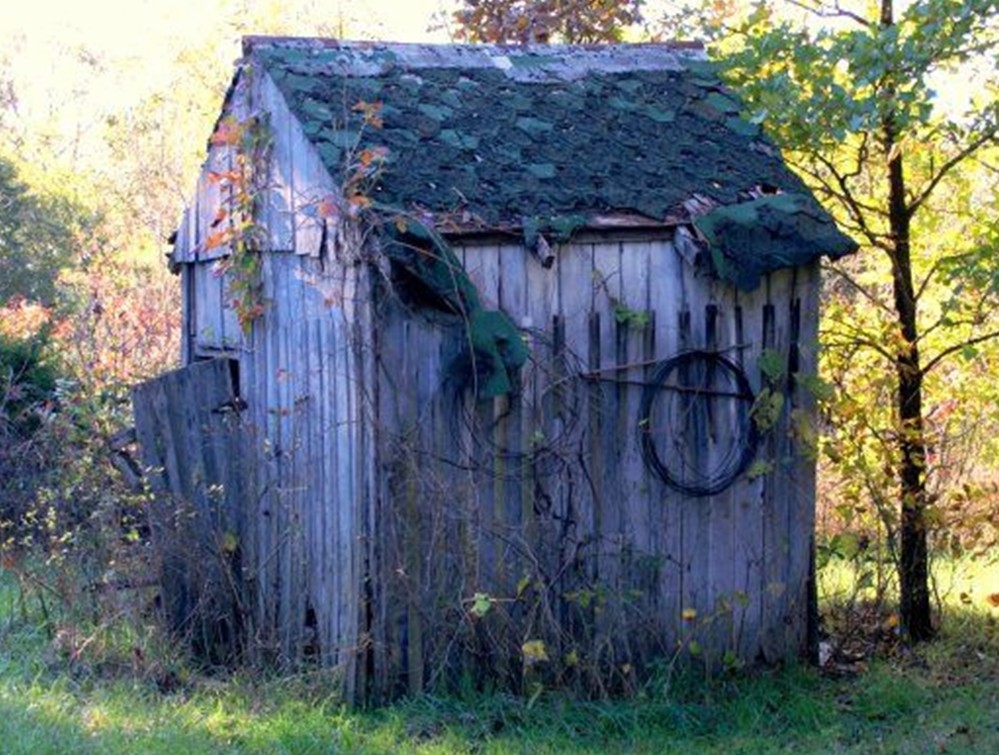
Yehuda Amichai’s lines about an old toolshed, saying so much about how we can ‘read’ a toolshed as a toolshed, or spend time to read more deeply, and discover that a toolshed is love, and a great love at that, leaves me with so much more to consider about language and ways a great love can be dismissed or discovered in the most unlikely places. I also like his lines there, to hand every time I open this collection, so I can read them and appreciate them as often as I want to.

Next time, I’ll try to figure out why a more narrative poem in the collection went where it went, and why, and why I wanted to keep it. Because a narrative poem, too, is a made thing.