My way of celebrating ‘Harper Gone’

scan justin0001When I launched Arctic Twilight: Leonard Budgell and the Changing North in March 2010, we were fortunate to be able to do that in the house of parliament, in the office of Liberal Senator Bill Romkey. Many MPs came, as well as senators, Liberal and Conservative.  Justin Trudeau was just an MP back then, but he came, lined up (twice) bought the book, had it signed and then at my request signed mine. I’ve never published this photo before, but he kissed my cheek!

The photo juxtaposition of this photo with a brochure from Haskapa, the company in Mahone Bay, NS, that produces deliciousness in various forms from the the haskap berry, is because my poet friend Janet Barkhouse who lives in Mahone Bay, sent me samples of their products.

I was keeping the jam for a special occasion, so this morning I celebrated Harper’s going with toast and Haskapa jam. Thank you Jan, it was perfect. The berry is rich in flavour so you don’t need much on your toast. Usually I pile jam on, having a real yearning for intensity. Not necessary with Haskapa jam. A little goes a long way.

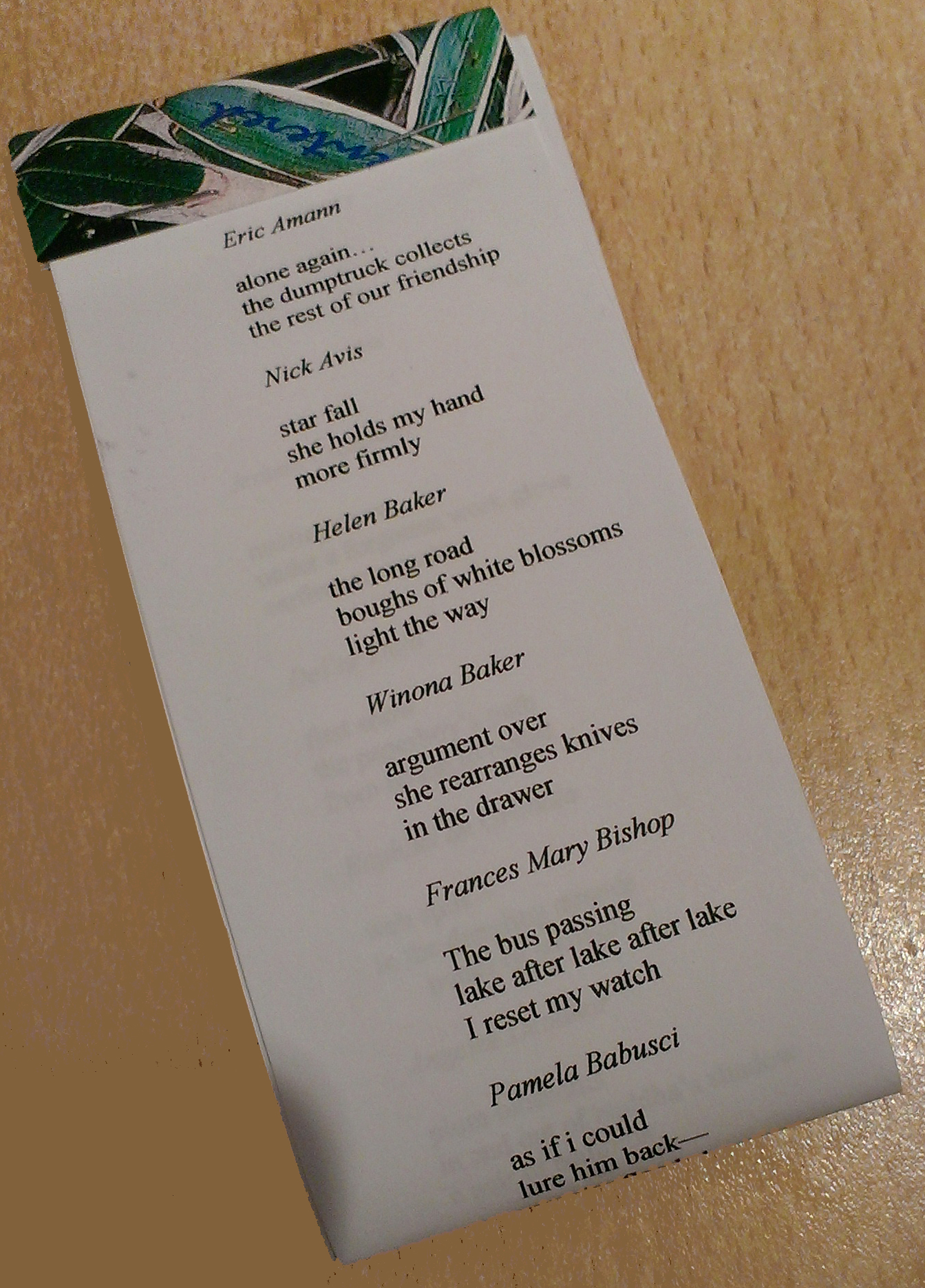
To further this celebration I reread Janet’s chapbook Silence. Here is an excerpt from those poems:

snapshot: gneiss


scrub spruce

a windfall log

three man outcrop


fold on fold

their faces tell

time’s pressure


war    love   lust

lessons learned

and loss


now rest and a tot

against

winter


three men making myth

how far they walked to get here

how long ago they left


For info on Haskapa products, go to haskapa.com. Many thanks Janet, for the chapbook and a lovely day of celebration!


A Thousand Fireflies

Today I’m featuring tanka by Luminita Suse of Ottawa. luminita

From the start Luminita was a natural tanka poet. These tanka are from her book A Thousand Fireflies/ Milles Lucioles, (2011, Ottawa, Petits Nuages), with translations by Mike Montreuil.

his face on my mind
I walk dark streets
yet all I see is light
imagine it even
on the other side of the moon

son visage dans mes pensées
je marche dans les rues sombre
je vois seulement de la lumière
imagine cela
l’autre côté de la lune

Her tanka take me so many places, many of them interior. They are fresh and straightforward.

again you don’t
answer phonecalls
today slowly
becomes the time
friends start to change

de nouveau tu ne réponds pas
aux appels téléphoniques
ce jour deviant lentement
celui où les amis
commencent à changer

We are familiar with feelings like this. There’s a vague hopelessness, but with an understanding of important things learned and accepted. There is a broken heart, but a wise broken heart. The breaking has allowed something greater in.

not easy
the way out of sorrow
only the moon
passes through
pine needles

ce n’est pas facile
de s’évader du chagrin
seule la lune
passe à travers
les aiguilles de pins

From deep sorrow, a brightness that comes from a simple observation. The moon passing through pine needles as metaphor for transience as well as oneness…

It’s always a pleasure to read Luminita’s poems!


Alice and Lucinda

lucindaIn June 2015 Lucinda Williams and her father Miller Williams, an internationally known poet, sat together to make a video.  Grammy Award Winner Lucinda has written a song called Compassion based on her father’s poem of the same name.

It was the last time they were to see each other.

On YouTube he reads his poem, and then Lucinda sings her composition Compassion. You can sense how proud he is of her. He’d often appeared with her, reading his poems between her songs. No big ego from either one of these two talented creators.

In the video, it’s clear that Lucinda had entered her father’s poem and made a different kind of ‘art thing’ from it, a song.

Obviously he didn’t think the song was a lesser art form than the poem, though I can see how some might.

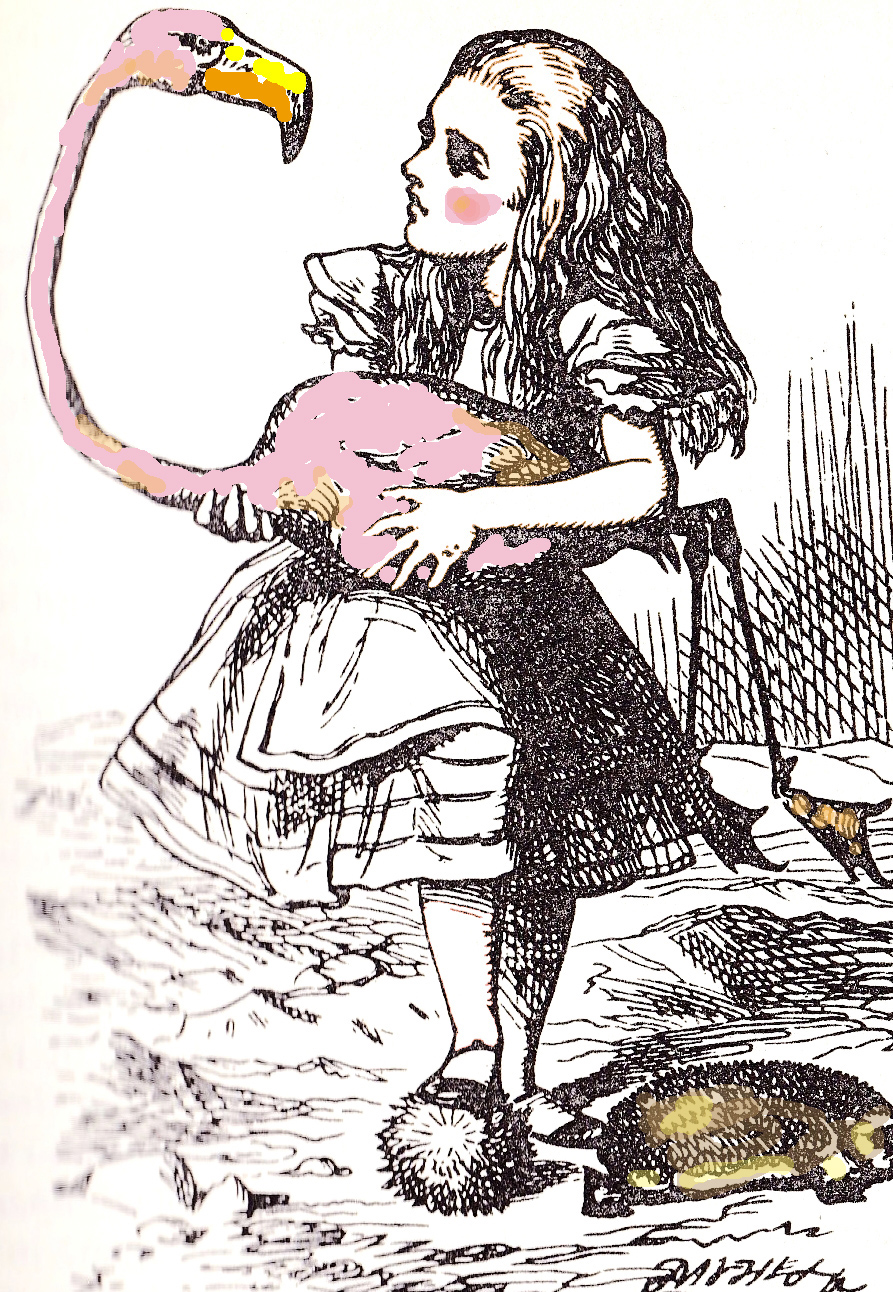
alice the flamingo coloured

I wonder whether Lewis Carroll would have minded that I stepped into Wonderland to have a look round.

In Three Sets of Literary Haibun, I did just that.  Let’s join Alice at table with The Mad Hatter and friends.

“I beg your pardon,” said Alice very
humbly; “ you had got to the fifth bend
in the story, I think.”
“I had not!” cried the Mouse, sharply
and very angrily.
“A knot!” said Alice, always ready to
make herself useful. “Oh do let me help

to undo it!”
insulted
by this nonsense
a dormouse growls

It is a little aside, something Carroll may not have noticed, or wanted to put into his account.

The senryu doesn’t complete the story, it merely connects with what we know to an unexpected sound from the dormouse. A dormouse makes little squeaking sounds but sounds its time sleeping. Here the word ‘growls’ indicates a dormouse having trouble sleeping because of the noise and squabbling at the table, a grumpy mouse. Just now, I googled ‘dormouse sounds’, and herd its squeal. If I’d done this earlier, I might have written ‘a dormouse chatters his teeth’, which seems to be another dormouse sound.

In the next haibun, I focused on the lowly Queen’s Gardeners.

“Would you tell me please,” said Alice
a little timidly, “why you are painting
those white roses?”
“Why the fact is you see, Miss, this
ought to have been a red rose-tree.”
The Queen! The Queen! …and the
Gardeners instantly threw themselves
flat on their faces.

paint drops drip
from petals
the knaves stressed out

Alice in Wonderland is as contemporary today as it was when written. It’s worth rereading it to note the parallels in our own lives and governing systems. In this set of thirteen haibun, (as in the other two sets on the poems of Gary Geddes and Sue Goyette, I use the author’s words, or a precis of them, in the prose part.

In Alice’s day, people seldom worried about how they felt about the servants and their difficult work and long hours. Twelve hours a day over hot tubs scrubbing and then ironing with heavy irons, or cooking below stairs. They paid insignificant wages so that they could have boiled collars and twelve course dinners. Stressed out.

The Red Queen is a bully. She doesn’t worry about how she made anyone feel, and you could empathize with those gardeners doing their very best, always on the brink of having their heads cut off, and never expecting mercy. Life was absurd, and they had to get used to it.

Sort of like being Aboriginal, or a scientist, a veteran or a creative person under Harper’s Conservative government. After Alice leaves Wonderland, what happens next…

from poem to poem/ Peter Richardson and Sue Goyette

richardson goyette covers

I was no end pleased when Peter Richardson decided to write a poem triggered by one of my own.  I had written ‘braiding afield’ about a woman engrossed in braiding the wild long grasses near her home.

a blonding begins a dying/living as plaiting is tightened as tight plait

snakes this way that with no knowing of an eta or of any t at all or a


grasses selected at random in the right/ wrong place at the happening

grass used to this using being used used to being bent and scythed


yet this furzed exhilaration new extraordinary existence grass slidden

through handskin-covered muscle bone twisted and who will who will


see the braid in this abandoned field …


Peter responded from the point of view of someone watching, with “At Portsmouth Acres Townhouse Village”:

…Was it harmless? Braiding viper’s

bugloss and vetch–did she wear

gloves? Itchy work that. Making tresses

that snaked between our aligned backyards,

hauling herself in that sack of a dress

under a wall of cobalt blue clouds

that held off and held off as if

she were in cahoots with cloudbursts,

why it begs the question: who was she

and where can we apply to have her returnin

to give us lessons in the minutiae of weaving grasses?

Though his protagonist was observing the woman, he was also inside of the poem with his knowledge of what kinds of ‘grasses’ were being woven, the deep blue clouds over him, the thought that she might not finish the task before the clouds burst. He was inside the field yet outside it, looking at it from a different place, and trying to make sense of what she was doing.

Using the same idea, I wanted to step inside the poems of Sue Goyette in Ocean (2014, Gaspereau Press) shortlisted for the 2014 Griffin Poetry Prize.

It has been one of favourite collections ever since it came out.  I read it through several times, beginning to end, reveling in her lush language, rich images, her sense of humour.

But I wanted to know the poems more intensely, so I chose 13 of them, (along with writings by Lewis Carroll and Gary Geddes) for a chapbook Three Sets of Literary Haibun (2015, catkin press), held up my skirts, and sloshed inside of them one at a time.

The poems are a history of a community living by an ocean with personality trying to come to terms with its vagaries. It’s a long lesson in cooperation, conciliation, dealing with frustration and politics, its mythmaking, and absurd explanations, a discovery in how to live with a magnificent ‘creature’ that nibbles away at, and batters, the shores. In this poem, a ‘squadron of cooks’ makes a meal to appease their off-landish neighbor:

An excerpt from Ocean’s poem eight:

                                         They peppered their soups

with pebbles and house keys. Quarts of bottled song


were used to sweeten the brew. Discussions between

preschool children and the poets were added


for nutritional value. These cooks took turns pulling

the cart to the mouth of the harbor. It would take four


of them to shoulder the vat over, tipping the peeled

promises, the baked dream into its mouth.


And then the ocean would be calm. It would sleep. Our mistake

was thinking it would make us happy.

I wanted to be there, with the cooks, one of the desperate shoreline residents, throwing ingredients into the soup, trying to satisfy Ocean.  Based on the poem, this from my Three Sets of Literary Haibun:

eight

The trick to building houses was to make sure they didn’t taste good. The ocean ate boats, children, promises and rants, even names. We tried to satisfy it―cooking cauldrons of sandals and sunglasses, quarts of bottled song.

calming an ocean

the child

tells of a dream

Our mistake/ was thinking it would make us happy, and isn’t that what nurturing is, why we feed people, not just our children, and why we celebrate with food.  We want family and friends to be happy, and what better way to try to befriend such a strong and unpredictable neighbour. We make mistakes like this, think simple solutions, what will work in everyday situations, will work in all situations.

In any case, you should get hold of a copy of Ocean, and spend time with each poem. You may be inspired to write a haibun from one of them. Or you may decide to use someone else’s work, and write a poem or haibun from inside it.

For a look at haibun based on Gary Geddes The Terracotta Army, go five posts back to LITERATURE TO HAIBUN/ INTRO TO LITTLE LITERARY HAIBUN.


More About Leonard Budgell and Arctic Twilight

len henry charlottelen at henry's 90th crop

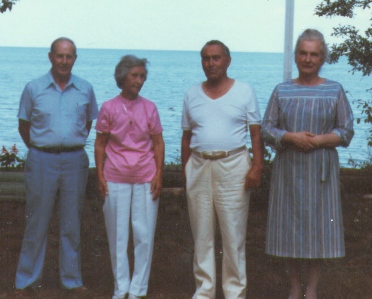
I never tire of seeing photos of Len with his friends and family. Here he is in a visit with  Henry and Charlotte Voisey, c. 1980. In the first photo, from the left, Len Budgell, Charlotte, Henry and their daughter Mary Voisey. The second is Len at Henry Voisey’s 90th birthday party.

When I met Leonard Budgell almost by accident in 1978, he was 25 years older than me, about the age of my father, yet we became the best of friends. Len was closest with friends like with Henry Voisey and Charlotte, both of whom were from Labrador, and who were, in Len’s own words, of ‘Eskimo’ descent. Henry was an HBC man, and a radio operator, as Len was. You will love their faces, he said. He’s short and solid and square, and she’s small and birdlike and so warm. 

you told me
of their collection
of stone and bone scrapers
sculptures carved
from dog’s teeth

There were so many things Len and I could talk about with each other and with no one else. We were safe with each other, and there was trust. There are 17 hours of oral history on tapes in the Hudson’s Bay Archives, orchestrated by Jocelyn McKillop, but the hundreds of hours we spent over meals, tea, walks in Oak Hammock Marsh, or Bird’s Hill Park, at MacDonald’s while we watched his grandchildren play in the “Play section’ are mostly lost.

tallgrass

we watched the geese
lift from the river
together as one
as one we knew
there was no next step

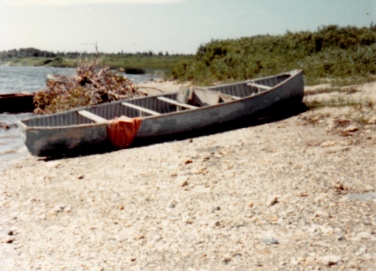
I visited him in Moosonee in the 1990s where, after his Hudson’s Bay Post Manager career, he managed Federated Shipping for The Hudson’s Bay Company. That company shipped equipment, food, and basic supplies to communities on James Bay. He visited me when he came to Oshawa from Winnipeg to see his daughter Kathy and his grandchildren. We met in Toronto, Kingston, Ottawa, Sharbot Lake…and during these visits we talked, with satisfying bouts of being quiet together, listening to coyotes howl, watching for bear prints on the beach.
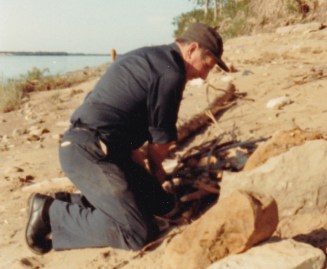
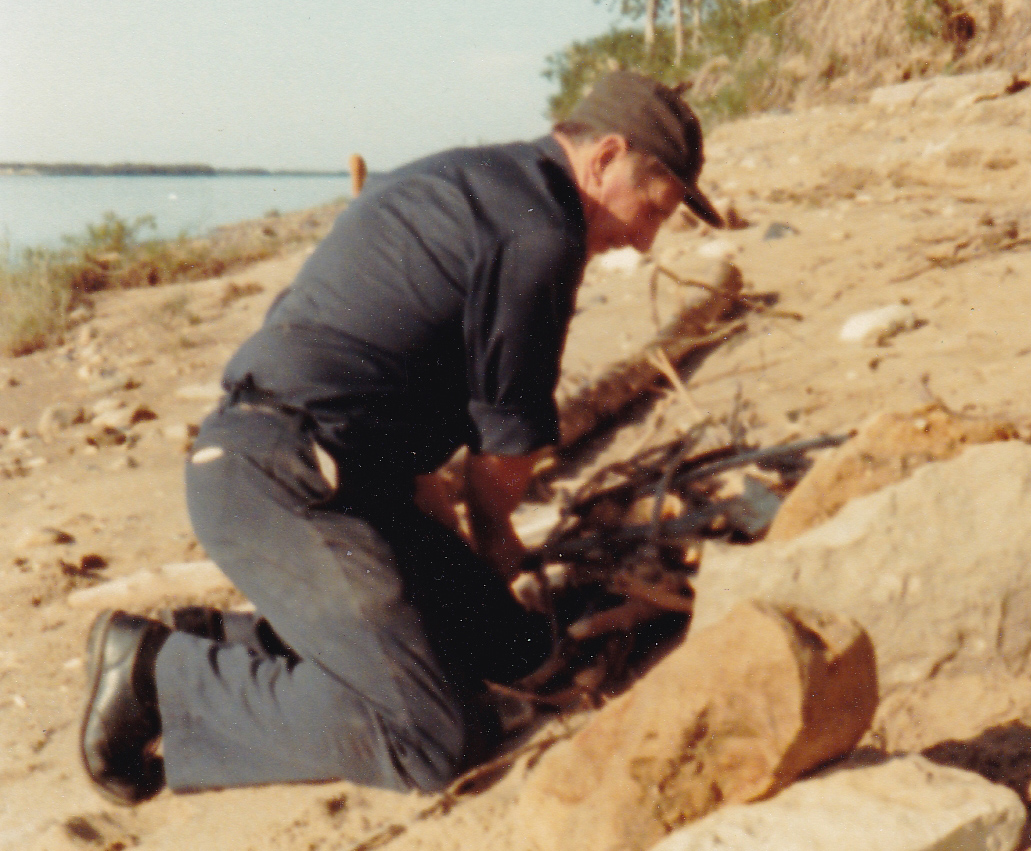
island at moosoneelen building a fire

I especially loved our time in Moosonee, I reveled in the the clean fresh air, in our canoe trips on the river, flights over James Bay; I was spoiled by Asheurias, the wonderful cook for the people who worked with Len. Ash would say, Eat it all up, maid, and present me with enough Newfoundland-style cooking to feed the whole town. And Len and I talked into the small hours.

I wish I had some physical record of more of his stories: the one about a criminal wearing a suit, and carrying only a suitcase who’d come through Hebron and stayed with him briefly; a tale of how the crew of the Nascopie once stole a goose he’d roasted at Hebron that showed another side of his usual peaceful nature; of the Inuit man whose wife needed delicate care that only Len could provide; his own story of his courting of Muriel, their long love and the bringing up of their children. And many stories of Hebron, one of the places he hoped to show me one day. (I got there in 2005, five years after he had died.) One thing we never talked about was our own dying: I was unprepared for his.


this is where you lived
among hebron’s hills
here the garden
the graveyard
its picket fence

Several times I nearly died while I was in Vanuatu, and there were many times he could have died on his postings. I never told him of my encounters with the Grim Reaper, nor did he regale me with his. If he mentioned, as he did in a letter quoted in Arctic Twilight, some glitch with his heart, it was a humorous recounting, after the fact. If he had outraced an avalanche, that was merely a lucky victory over the bleak fellow in the hoodie. Our own demise wasn’t a subject to be avoided; it just didn’t seem that important. Neither of us was afraid of it, neither attached any importance to philosophizing about what happens after death.

He worried more about suffering, but it was the suffering of others he lamented. He worried more about what was happening to all those in small communities in Labrador, the conditions they were living under, the alcoholism, the young peoples’ suicides.

at saglek harbour
no one left now
to listen for
the almost noiseless feet
of caribou on muskeg

In Ottawa in the mid nineties, we were visiting a friend of his, a brilliant and well-known elderly anthropologist, to hear his views on an early version of Arctic Twilight. Afterwards we went to what was still called The Museum of Civilization, in Hull. Cardinal’s curving building meant to him the snowy Mealy Mountains in Labrador where he had often hunted. Some of these experiences are in Arctic Twilight, but I remember particularly two things about that afternoon. The first is that after we took in the totem poles and the exhibit of the Eastern Aboriginal culture, after he spent a long time with a York boat that brought people and goods to places like Fort Garry near Winnipeg, he seemed tired. It was the first time I had ever seen him tired.

like your brother max
who once walked
across Labrador
to enlist
your boundless energy

He was about eighty years old, yet it took me by surprise. In my mind he had always been energy personified, a person who got up every morning at 5:30 and did useful things until he went to bed. The useful things included writing letters to friends, to anyone who wrote to him. He wrote stories, sending several to Them Days Magazine in Goose Bay, Labrador, and he wrote letters to the editors of the Whig Standard newspaper and The Beaver magazine to comment on mistakes that ‘those idiots’ had published without sufficient research.

in this small cave
you ate with a friend
it was dark
all you could see were
his strong inuit teeth

His home in St. Boniface was spotless and cared for; after Muriel became ill, he took on the responsibilities for all aspects of taking care of the house. He had a wonderful garden with incredible produce, and he planted, weeded, and harvested produce from the fertile soil of a younger daughter’s garden on a farm outside Winnipeg, looked after his grandchildren as often as he could. He had lunch with his old-timer friends from The Hudson’s Bay Company, and kept an office at the Company’s main headquarters for years after his retirement. He visited with his Mennonite and Ukrainian friends.
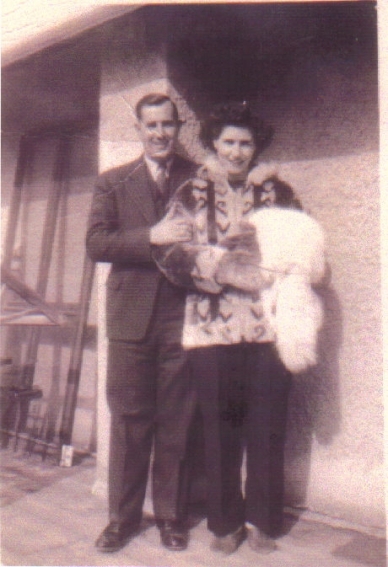
len and Muriel on board ship

Muriel had been diagnosed with Alzheimer’s and was often in pain from arthritis; there were hospital visits, home visits; he himself had some heart problems but despite tests and drop-ins at the cardiologist office, he kept on going. He liked a clean house so he vacuumed and washed floors and did laundry. He made jam, preserved fruit. Wild cranberries meant dozens of jars of jelly, and he helped as much as possible in the kitchen, especially on clean-up. His driveways were shoveled before full daylight, and he helped with his neighbours’ shoveling too. In spring, he’d be off to the Marsh to see spring happen there.

storm clouds lift
on the beach at iron strand
roseroot sedum glistens
the shorewater
settles

But at the museum he was a little slower than usual, happy to sit with a coffee. He did, though, want to see the Arctic exhibit. This is the other important thing I remember from that day. When we entered the exhibit, there was a long wall with life-sized photographs of some Inuit, smiling at the camera, as if in welcome.

Well there’s ( an Inuit name)…!, Len said, his face brightening. And there’s his brother, and his father, giving their Inuktitut names. He named several others on the wall, and since my memory is not anywhere near what his was, I don’t remember the names or what else he told me about these friends of his that graced the Arctic Exhibit. I wasn’t surprised that he knew their names, or these people.

coonera
the last man to come up
and grin in my face
not letting on to the spirits
about my journey

Hindsight is a grand thing, he would have said, but only years afterwards I thought Why weren’t the names of these people there identifying them. Of course, that day, I didn’t think to write the
names down, or suggest we get the Museum to put their names with the photos. Probably only Len knew who these men were, and it was a bad slip-up on my part not to have done so.

in this small cave
you ate with coonera
it was dark
all you could see were
his strong inuit teeth

Perhaps it was part of policy, or just habit, that names of native peoples were not recorded. I never could find out the name of a native person in a photograph of Len’s father when he was a young Servant of the Bay at Davis Inlet, although the native figured as large as George Budgell did in the photo. Since Len himself was a very small boy at the time of the photo, he didn’t know either.
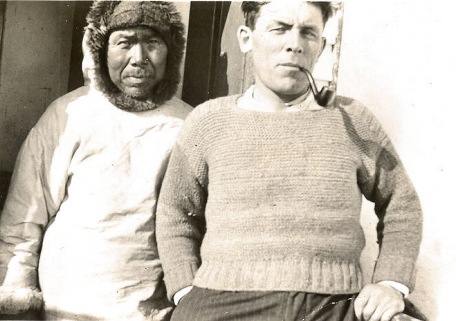
George Budgell and an Inuit man

This is the photo of George Budgell, Len’s father, taken around 1927. Afterwards I saw that in so many archive photos, whether in the National Library, The Manitoba or The Hudson’s Bay Archives, even the Labrador Archives in The Rooms in St. John’s, only the names of the white people were noted.
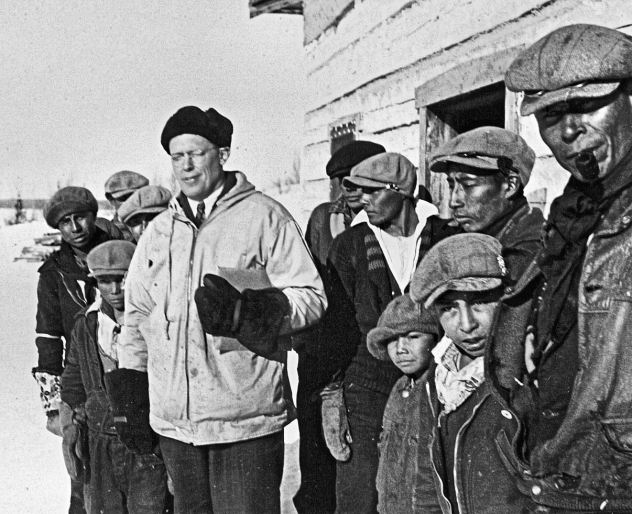
WEBrown

Here is his great Hudson’s Bay friend, W.E.Brown, whose story runs through Arctic Twilight. (Brown had been a Mountie in the North before starting his career with The Bay.) Len never saw this image, but he would say that ‘Buster’ Brown would have known the names of most of the people with him here. I never saw Len with a camera, though he didn’t mind being photographed. He didn’t need an image to help him remember, and perhaps he felt that by isolating one moment, he would not remember other details associated with it.

Leonard remembered all the names of those he had dealings with, especially people like Millik whom he respected and cared about, making no distinction as to whether they were native. In fact, a person interested him more if he or she were native. Every single one was an important person, no one more important than the next. There are some who would have wished he hadn’t remembered their names, for he never forgot those who acted unethically, especially if they were Hudson’s Bay employees, historians, writers or publishers who had not done their research in the history of, or the vessels owned by, the Hudson’s Bay Company.

millik was big for an eskimo
competent and honest and powerful
his face would break up
up into a hundred
heart-warming smiles

Once when he was visiting me, having arrived in Kingston by train from Toronto, my car broke down and a tow truck called. He had to be lifted by the driver into its cab for the ride to the garage, and in my home, he wasn’t jumping up to make tea or suggesting that we walk in the woods. When on his return trip, a porter who saw he had difficulty getting into the train suggested he have a wheelchair waiting in Toronto, he shook his head. Of course he wouldn’t need one, yet in his next phone call he admitted that he wished he had said yes to that plan, that the station had seemed very big to walk across that evening. But he hadn’t talked about his pain; it was as if he figured if he didn’t mention it, it didn’t exist.

you hunted
in that time of famine
shot one
thin fox
and gave it away

Early December of 2000, I got a phone call from Len’s youngest daughter saying that he’d been operated on for a hip replacement, but that he’d gone into a coma. Of course, he hadn’t let me know that he was going to have the procedure. He wouldn’t have me worry. He’d let me know once it was all over. I asked if she would go in and tell him that Claudia says she loves you.

The next day, a second call. Her father had not survived.

I did as you asked, she said….We’re so glad that you were in his life.

According to his wishes, his ashes were scattered in Labrador over the graves of his parents. If he’d thought it possible, he would have loved to lie on the Iron Strand of Labrador where I found a grave heaped with stones. He most likely knew of this grave, and might have thought, as I did:

whoever is in this stone grave
how i envy him
he will never have to leave
the labrador
or these sunsets

glacier worn mountains
one behind the other
you spent many an evening
absorbing the order
in this solitude


Grant Savage/Masud Taj

grant x h-masud-taj-532-600

rainy day
on the floor a puzzle piece
of blue sky

Today a puzzle piece takes over.  It’s the perfect poem for today as the sun has relented a little and we are not sweltering, but upon my opening Taj’s masterful rendering of Grant’s poem, the sky has become blue again.

This time Taj received four poems and chose this one. I have no idea how his minds works to create such a thing of beauty, whether he ‘sees’ the haiku in this form from the start or whether it develops as he puts writing instrument to paper. I like to imagine his process, though I realize how useless it would be to try.

Except for the aura of peaceful concentration that must hover about him as he begins.

The poem itself, with its economy of words the nouns ― day, floor, piece, sky. This is where the master haiku writer shows up. The nouns are modified by only two words ― rainy and puzzle. Then two prepositions and an article. From these ‘word puzzle pieces’ describing what he saw, he lets us into the picture. He takes us out of one weather situation into another, possibly of the mind, a neat trick.

There’s a turn in the poem after the second line, and Taj picked that up and literally ‘turned’ the third line, making it look like a reflection. That says that this is a poem to reflect upon. It says remember those too-long summer days when we were (are) locked inside, and the things we do to make the day pleasant. This poem is all the stored boxed games of our youth. It is getting together with friends or family, it is competition on a grand play scale. It is what we can do instead of taking our mood from the weather, it is our ability to metaphorically make our own days sunny, and so of course, to stop puddling around in our ‘miseries’ and do something about our life in general. It is a haiku that reinforces what Rilke wrote: You must change your life.

That short last line does so much, in words, and now in this graceful rendering of the haiku. What I truly love about this poem and its beautiful interpretation is that both are brief, that artist and poet simply set out to do their job as artist and poet, but that they have done so much more.

That Taj is a magical poet in his own right would have given him insights that moved his hand and his mind to create such a moving piece to match this poem. That delightful physical expression of ‘rainy day’ falling so perfectly into the rest of the poem.

Grant D. Savage is an Ottawa poet and photographer.

H. Masud Taj is a roving poet and Adjunct Professor at the Azrieli School of Architecture & Urbanism, Carleton University, Ottawa.


China in Tanka/ Terry Ann Carter

Yangtze Crossing, Terry Ann Carter (2009, Bondi Studios)

yangtze cover 2In 2005, Terry Ann Carter accepted an invitation to teach at the International Educational Exchange Center at Dongzhou Middle School in Haimen City, China, a Summer Language School for Teachers. She suggested we do this together. We both found the five line Japanese form of tanka to be the best way to express our experience.  We published a set of chapbooks. Yangtze Crossing is Terry Ann’s collection. It takes you through her second trip to China, and my first.China 308
Yangtze crossing
I must be someone else
crossing the river
clouds drift
in no particular direction

In this poem Terry Ann Carter sees herself, a modern women from Canada, on a ferry in China in a country of millions of women whose ways of life we cannot possibly understand.  Initially the poem speaks of the natural astonishment of being in China at all.

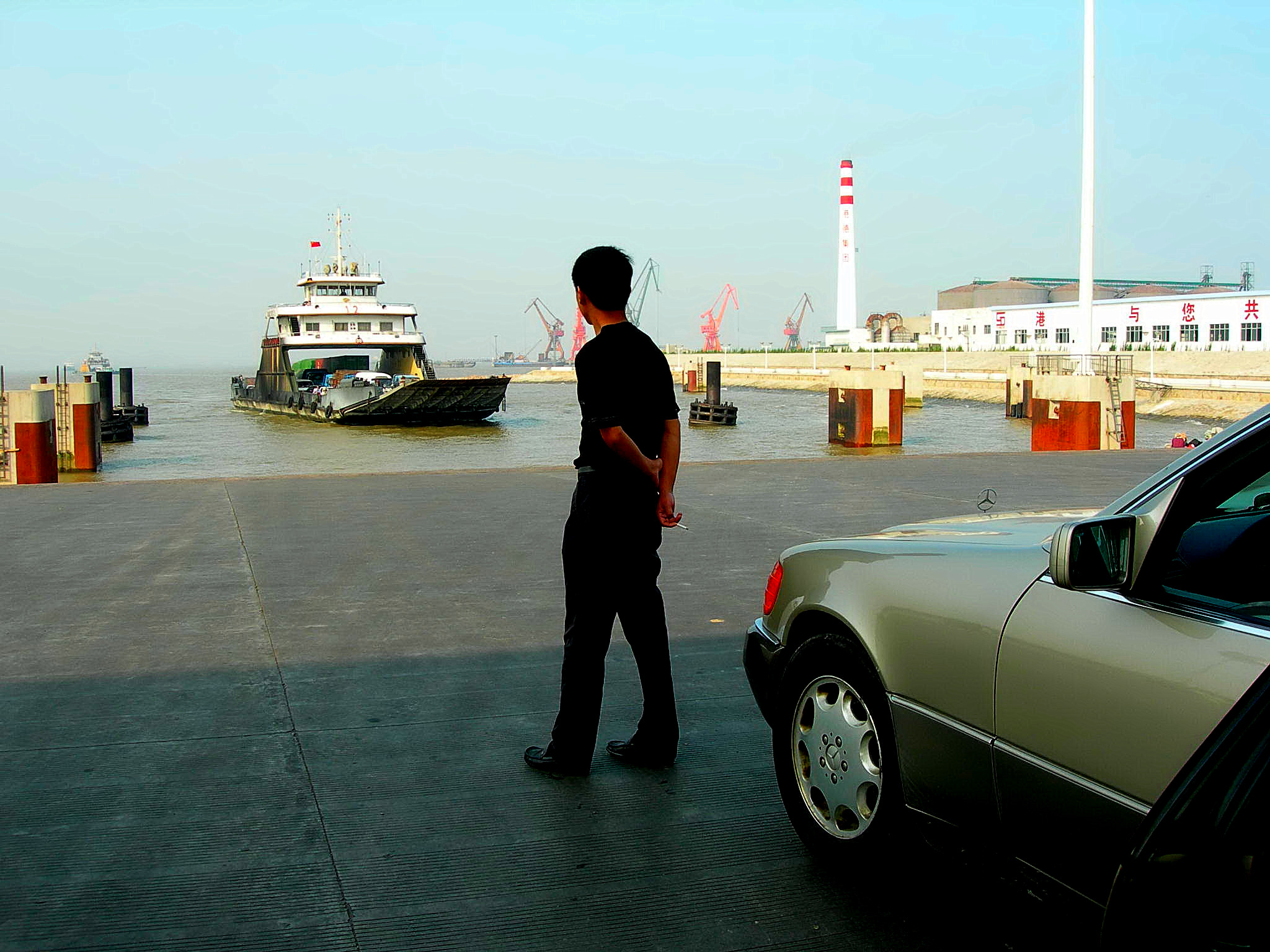
It is an adventure to cross the Yangtze, though today there is a bridge where we crossed to Shanghai from the north. The photo shows our chauffeur (yes!) waiting for the ferry beside our Mercedes (yes!!). Blame it on the heat and humidity, and/or being driven in China by a chauffeur in an air-conditioned Mercedes, but there was a sense of unreality despite the closeness of truck beds on the ferry loaded with piled cages of chickens, despite the small girl hiding bashfully in her mother’s skirts from the white devil ladies, leading to connections less concrete than what we saw around us, those of myth, poetry, and history.

The muddiness of the water and our muddy relations with this country, mud by the shore, too polluted even for reeds to grow through the trash washed up in the estuary.

Terry Ann Carter was also a different person than she was when she first came to China many years before.  Like the clouds, her mind was unable to settle for long on what her senses were telling her. There were so many changes, yet so much was unchanged.

Both Terry Ann and I, like children, wanted to believe in the China of poetry and Art, of beautiful clothes and elegant manners, not the condition of those hundreds of pathetic chickens in the heat.  We could only look up, where the clouds were drifting, unconcerned. Of course, clouds do not float ‘in no particular direction’, except that here on the Yangtze, with everything coming at us at once, they seemed to.  The line could suggest the opposite analogy, that in China there is only one ‘correct’ direction, but that there is a feeling in the New China that anything is possible.

lazy afternoon
from the teacher’s room next door
a pipa melody
and wildflowers spilling out
of a vase

This is how we knew we were in China.  After all, we’d been picked up by our chauffeur from the Shanghai Airport, whisked to Haimen City on a many-laned highway. In our separate rooms, we had a bed, desk, computer to use, and air conditioning, modern bathrooms and showers. We were teaching in a secondary school and had at our disposal up-to-date classroom equipment.  The giant department store on the corner had just about everything, except yogurt and eggs…

But to hear in the evening this pipa music, a fellow teacher who was a student of this ancient stringed instrument, going over certain groups of notes, honing melodies, was for the moment, our China, the China of a small city.

The flowers spilled, like the notes, gracefully.  The vase, a container of water, a symbol for the physical body containing a spiritual life, as the music ‘contains’ life for the spirit.

The poem is a reminder of our students, teachers themselves, with us to improve pronunciation of English, and to learn new English Language teaching methods. There is a vase, containing, limiting the amount of water which is transparent and easily poured away, easily lost, a lesson, sign of what is possible and not possible, a structural discipline. That much water in just that form.

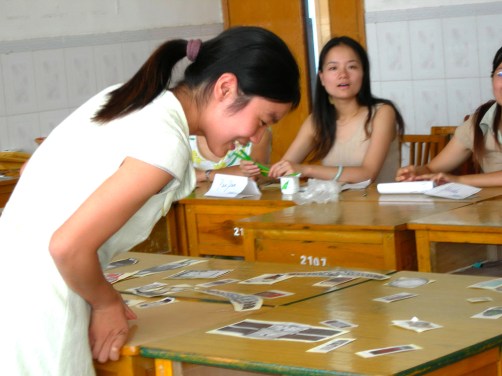
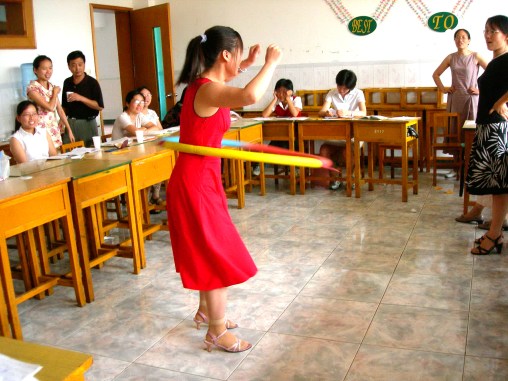
China 582It could be analogy for obedience and discipline, a ‘holding in’ first and foremost for Chinese students and Chinese teachers, for all Chinese citizens. Rules, philosophies and laws are cultural containers. This tanka is our friendly Director checking all my photographs before I left, is our students always wary of telling us anything about their personal lives, their families, or their teaching situations, and knowing that to exchange email addresses may be useless at best, if not dangerous. Vase as caution, solid and in a recognized shape.China 120The evaluation comments from our students were delightful and positive, and I’m sure they had a good time learning from Terry how to practice phrases while keeping a hula hoop going, or from me how to make collages and create stories and conversations about them.
But just before we left, a shy teacher came to me and thanked me for the new methods, but said none of them would be able to teach that way; they were told precisely what to teach and how to teach it, mostly by forced repetition and rote memory. If their students did not pass their exams in the manner expected, the teachers could lose their teaching positions.China 283This tanka, with its dreamy mood, is accessible however to anyone who does not know its background stories and/or associations. It is everyone’s memory of walking past a house, and hearing through an open window, someone playing Mozart on the piano, or someone practising something beautiful anywhere.  It leads to recollections of picking our own wildflowers in an empty lot, or in the country, or of stopping the car to choose a bouquet from the side of the road, or even wondering whether Chinese wildflowers are different from ours.

The next tanka is in a similar dreamy mood:

home from China
each rounded leaf
reminding me of moon gates
this summer night
fanning against my skin


moon gateI don’t know what particular plant Terry Ann was looking at in her home garden, but what was uppermost in her mind was not the plant’s name, but the shape of its leaves. This is one way memory works, a kind of synecdoche, a ‘part’, in this case a shape, bringing to mind a ‘whole’, not even just a whole object, but a complete scene.

Moon gates are almost cliché when thinking of China; every temple, every garden has one, and anyone having read or experienced anything to do with China, can’t help but having somewhat romantic feelings about them. Romantic is not completely the right word, but these gates in the shape of the moon and ouroboros signify myth, story, and mystery ― rabbits, the goddess Chang’e, moon as female principle (Yin), even the Good Night Moon storybooks we’ve read to our own children.

change e and rabbitLeaving aside our customary association of romance and moonlight, the romance in this tanka is in the delicate sensual phrasing of ‘summer night’ ‘fanning’ and ‘against the skin’. We are ‘touched’ in a metaphysical way, not quite physically touched, but as if our skin were being brushed by the summer air, a sense experience, a relationship between sense impression and its referents. In religious rituals relics are touched or kissed. Masons recognize each other by a handshake, Pygmalion had to first touch the statue in order to be moved.
‘Air’ has fanned against the poet’s skin, and she has made it touch ours ― touch as index to consciousness.  In this poem, touch is positive connection with memory, and with some things we already deeply know.

Here too is a physical structure in the form of not the moon itself, but what is outside the moon, the moon’s halo. It has given us a circle around emptiness, around what we don’t know, the art of knowing nothing.  It can be linked to the summer air, which we can’t see, but which we feel; nor can we see emptiness, no mind, the innocent mind, where it all begins and ends, but we can sense its truth, its essence.

To read Terry’s Yangtze Crossing is to give us an intimate picture of some aspects of Chinese culture ten years ago. Our students, the director of the Center, the secretary of the school and the principal were so warm and welcoming.

farewell party
students fold paper cranes
into a necklace …
like the morning moon
we will soon disappear


China 668

(We and some of our students and their friends at a farewell dinner)

Literature to haibun/ intro to little literary haibun


debs bookThis week, Ottawa poet and short story writer Deborah-Anne Tunney ― cover above of her book The View From the Lane (2014, Enfield & Wizenty, Great Plains Publications) ―  read us her poem based on a scene from Hitchcock’s ‘The Birds’.  She took us inside a kitchen, focusing on the tensions between Annie and Melanie. suzanne p

(Tippi Hedren, (Melanie) Suzanne Pleshette (Annie)

Ms. Tunney enabled us to concentrate particularly on two characters in a scene that is not as often recalled  as many of the others in the movie. Her poem introduced us to the women in an intelligent, intimate way, making it more memorable.  “…alone in the living room/ of that bungalow off a dirt road, speaking/ of Lydia’s mind shaped like a/ kitchen, the crazed cruel love Annie// keeps hidden in a cupboard…”

From one art work to another, a tribute. I think Hitchcock would have been delighted, just as Cavafy would be pleased at what his poem had generated for Leonard Cohen. To decide to get inside someone else’s work, to show that spending time with it is valuable enough for you to do so, is tribute; it can also be a fascinating adventure.  As well, for a practitioner of one form to create a new ‘thingness’ from an already ‘made thingness’ can make it possible for the original to reach a completely different audience/readership/listener, and all in the spirit of ‘upcycling’…

Remember when a poem was something you had to deal with. It was a part of the curriculum and often the teacher didn’t understand the poem either. But the Teacher’s Manual on page 214 had a description of what the poem was about.  Our job was to guess what was in that manual. Think of those essays set in which you were to analyze a piece of writing. Often you didn’t understand what was happening in the book, article or poem to start with. Literature was so dull. Précis…Ugh!

One way of understanding complicated writing, or to get closer to the intention of any poem, or even just to enjoy it in its fullness, might be to approach it as a method actor might do.

Whether the work is a popular play, or avant garde, the actors’ mission is to create in themselves a sense of the character, to get inside their thoughts, and develop the psychological, emotional feelings of those characters.  Some actors stay in character for the run of the play so they can fully experience living in the character’s life.

Recalling 19th century woodcuts by creating haibun, to create from Cavafy a contemporary piece of music, writing “The Birds” into poetry, forming a new poem based on another, is to disturb the finality of a form, to allow it to leak out into a different environment, a different time. This can be disturbing to the original creator who may feel possessive about his/her work; they may see it as a suggestion that their work is not already complete as is.

Yet to be excited enough about someone’s work to try it, is to attempt to integrate the source world with your own consciousness.  It is to realize that any created piece can have an unending future, even though the original work stopped in time when it was completed.

OLYMPUS DIGITAL CAMERA
As your personal one-point perspective engages with a previous creation, it communicates through an imaginary sense of touch, of atmosphere, a confronting.

Re-entering a piece of art can bring the original again to the attention of today’s reader, possibly a different audience, to have it reconsidered. Not ‘oh that poem again, I read that ten years ago…’ but a chance to react differently because you have placed yourself and others inside that stopped time, and shifted it to the present.

Because of this altered energy, a contemporary section of a work’s genealogy comes into being, as well as a new bridge to its future. In stopping the time of the work, it says Let’s get on that train, and stop at a different station. Have a look around. Let’s invite ourselves into Hitchcock’s kitchen with Ms. Tunney, sit down for a while with Melanie and Annie. Get to know them, ask different questions of them than Hitchcock did. Let’s watch the woman in the field with Peter, discuss why she might be braiding grass methodically as if it were her daughter’s hair.

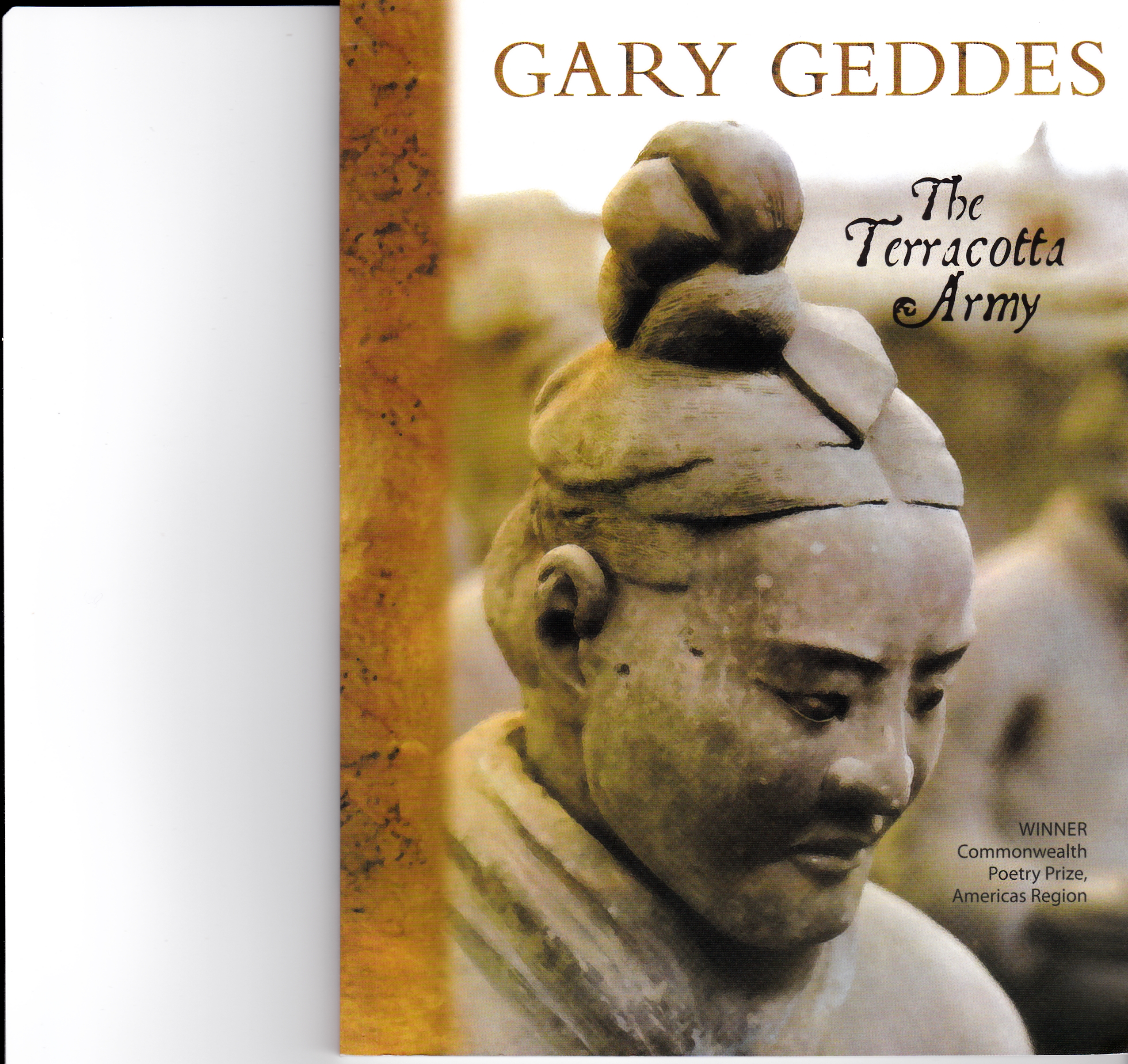
gary geddes cover soldiersRecently, with permission of the two living authors,  I invited myself into the lives of three different situations they have created, so I could get closer to imaginary people who represented real people, real conundrums, real relationships: The writers are Lewis Carroll, Susan Goyette and Gary Geddes.

This excerpt is from the third section of Three Sets of Literary Haibun, Gary Geddes and Claudia Radmore (2015, catkin press). It is based on ‘Spearman’, a poem from The Terracotta Army (1984, Oberon Press; 2010, Goose Lane Editions), winner of the Commonwealth Prize, Americas Region.

I have arrived in the workshop/studio of Lao Bi, the artist who sculpted the soldiers’ faces, and I sit quietly in a corner. For the artist it must have been the commission of a lifetime, the culmination of his life’s work so far. I imagine the Emperor summoning him, the artist in awe of the Emperor, and all the bowing involved in the meeting. Or perhaps it was done through an emissary. In any case, this Emperor was more like a god to Lao Bi, at least in his range of powers over a lowly artist’s life and death. I wonder what was going on in Lao Bi’s mind. Was he at all suspicious of the Emperor’s intentions…

Gary Geddes lets you see him through the soldiers characters and the artist’s interaction with them. A spearman enters the studio and Lao Bi tells him where to stand. The artist has a great many portraits to make in clay, and I imagine he was chosen because of his skills and his ability to work to deadline. Where the Emperor was concerned the word ‘deadline’, could mean just that, so he has to work quickly.  Here is a haibun from Three Sets written after Geddes’ ‘Spearman’ poem.

Spearman

He has worn his armoured vest and spear for the sitting.  Pleased, Lao Bi laughs out loud, creates an uncanny likeness―not just the face but the way the sleeves bunch up at the wrist, the studs and fluted leather of the shoulder pads.

ordered to the frontier/ the spearman leaves/ himself behind 

The haibun is consciously brief, and uses many of Geddes words and phrases, a sort of ‘found’ prose. In the original poem, Geddes builds the spearman’s character, recounting the soldier’s amazement that the artist can take his measure in a single sitting. That would have been the first sitting. It is in the second setting that the spearman has returned in full regalia ― proud of his calling, he strikes his own pose, a daring attitude in the presence of the Emperor’s artist ― and we see the artist suddenly liking the spearman, seeing someone he can relate to, and beginning a relationship with the soldier, with the man; perhaps he will share the contents of his wineskin with him, get to know him better.

Then the spearman is called to the front, and is reluctant to leave his village, but also, strangely , to leave this image of himself. You can imagine him wondering why it was important to him; there’s a sense of awakening. Today we have so many images of ourselves, but in Emperor Qin Shi Huang’s time, it was unknown to even think of such a thing, especially if you were a lowly person, like a spearman.

The original poem makes you aware that the soldier realizes that his chances of returning alive are slim. He may never survive the next battle, but now he knows there will be this sculpture left to remind others of him. There is poignance in the original, especially because though we know his statue would be buried for many centuries, he probably would not have known the Emperor’s plan at the time. This short literary haibun simply slips me into the studio, so that I can emphasize in the haibun the care with which the artist replicates the trappings of a soldier’s existence.

The haiku reminds also of the more philosophical implications of leaving ones’ self behind. It does what much of Japanese-form poetry does ― reminding us of the transience of our world.

Gary has created so many beautiful portraits, so many human soldiers, in The Terracotta  Army, and these few haibun are meant as small windows into this collection. In his introduction, you get to see how Lao Bi, or Old Bi himself becomes an interesting character in the poet’s mind, how he began to make his characters come alive for him..

These haibun will also serve to broadcast his work to a different audience. In October I will present this kind of ‘living inside another writer’s work’ at the Haiku North America Conference in Schenectady, New York.

Many American haiku, tanka, and haibun poets will attend, as will several poets from other parts of the world who might not have heard of Gary Geddes’ work. He is well known in Canada and among lyric poets, but this will be outreach to a different readership; once they hear about Geddes’ poems through these thirteen short haibun about the Terracotta Soldier, they will want to read the originals.

Gary, I will only take a small cut of the sales profits.

In a future post, I’ll continue with little literary haibun based on Ocean, (2014, Gaspereau Press) by Sue Goyette, and Alice in Wonderland, by Lewis Carroll., from my Three Sets of literary Haibun. 


Philomene Kocher’s haiku/ H. Masud Taj calligraphy!

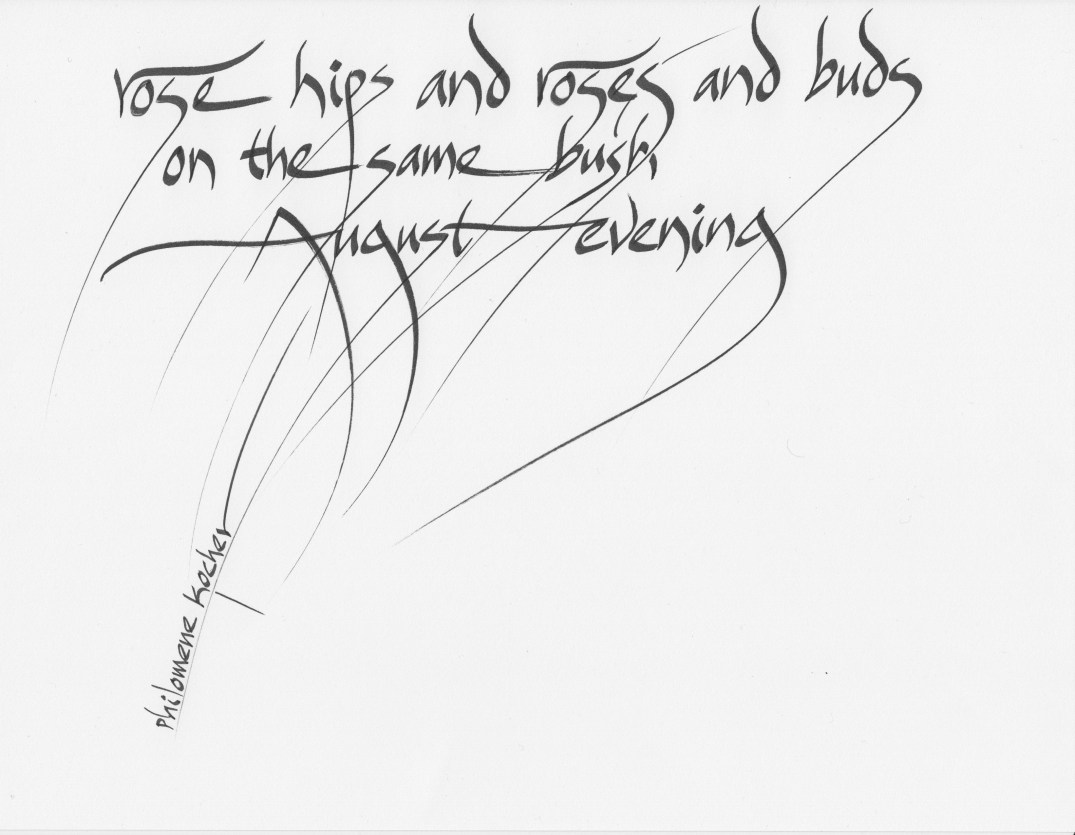
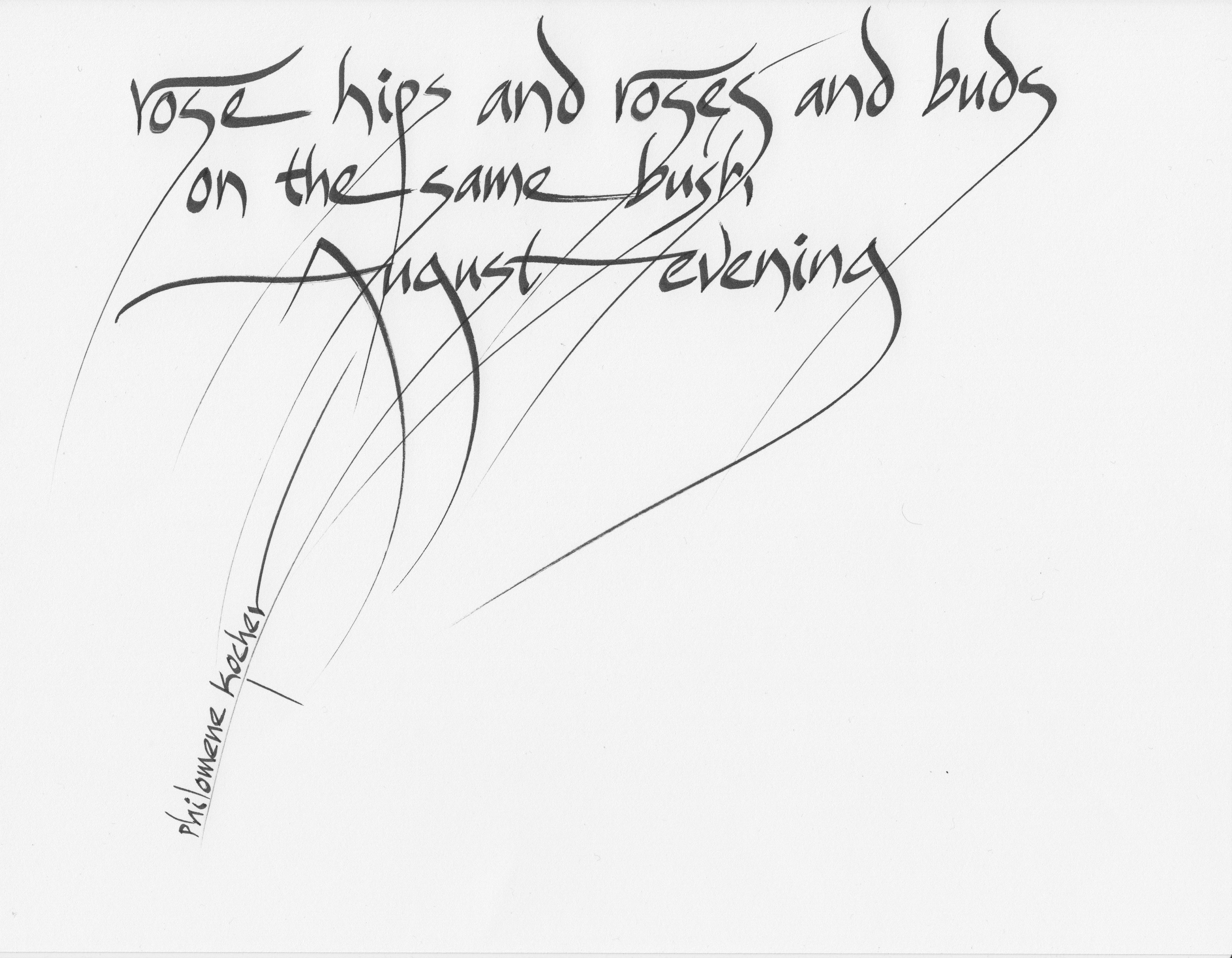
Just look at this calligraphy! Every once in a while someone will make an offer you can’t refuse… In this case poet/calligrapher/architect/professor (and more) Taj emailed that if I would send him a haiku from one of my haiku authors, he would rewrite it in calligraphy to put on my blog. Rose (1)

I sent him Philomene Kocher’s poem:

rose hips and roses and buds/ on the same bush/ August evening

I sent this one to him because another of her publishers, Marco Fraticelli, said it was one of his favourite haiku, and I think it is deserves to be portrayed through Taj’s art. .

Taj and Bruce Meyer co-authored Alphabestiary: A Poetry-Emblem Book (2011, Exile Editions). Taj will probably say that this post was not supposed to be about him, so I won’t go on about his careers and publishing history, all of which you can discover yourself on the internet. (Actually Taj, I would like to do this myself on the blog one day…) I will only say further that when he is able to join one of our Ottawa poetry critique groups in Ottawa, (he is often away in India and other far Eastern places…) we learn a lot from what he sees in a poem.

Philomene Kocher is another poet who will  seldom get up on a podium to say much about herself, but she is a sensitive writer who is concerned about writing good haiku, and works to introduce others to this form of poetry. She has spoken at conferences, and worked with seniors who have lost great chunks of their memory, finding new inroads to their minds through haiku, while helping them to express themselves through the form.

Her poem is the perfect one to be highlighted today. The calligraphy adds new dimensions to her observation about the rose bush, making us want to linger even longer with her words. Thank you Taj! Thank you Philomene!


Thousand Leaves, Karuta Haiku Canada

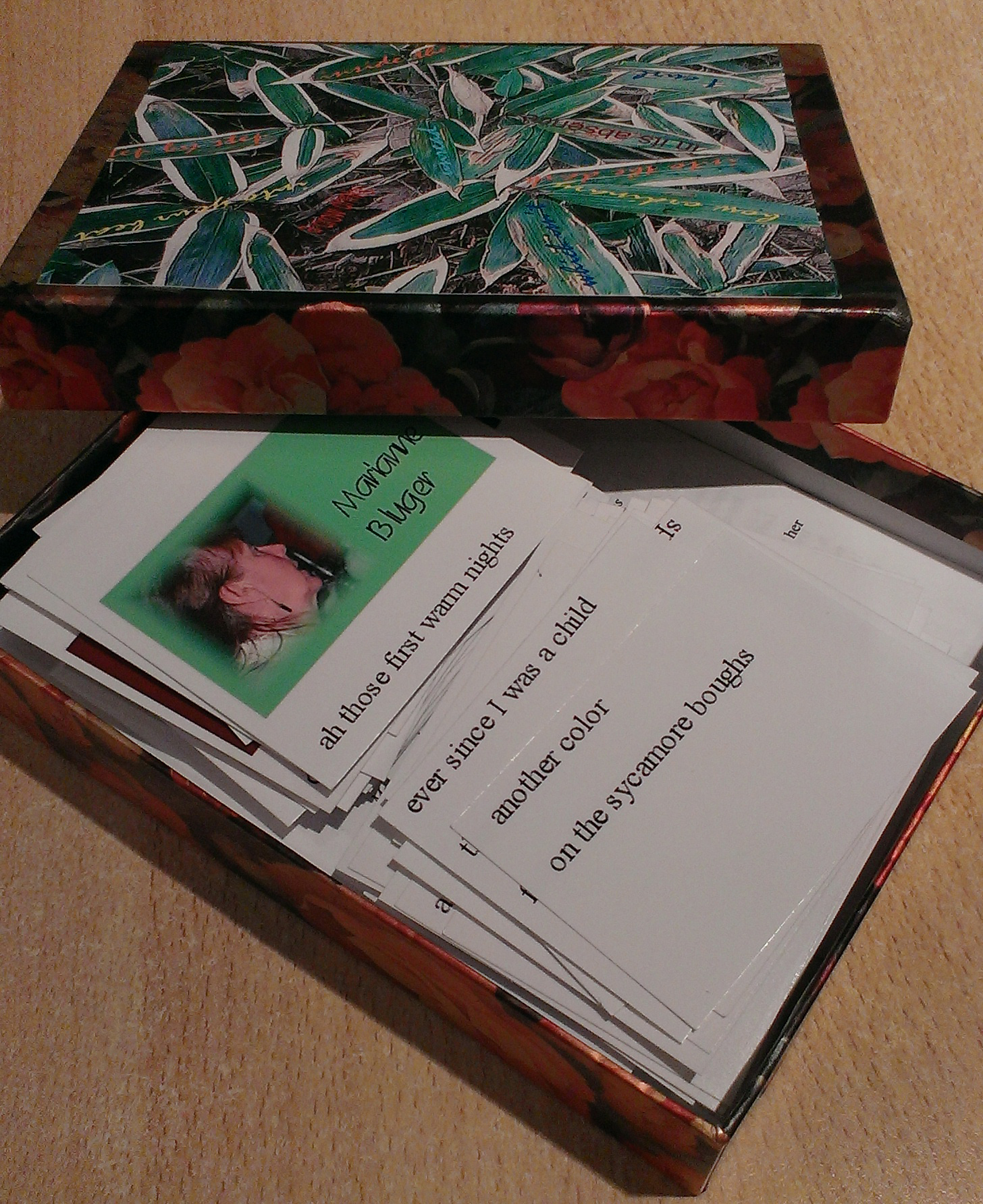
Thousand Leaves, Karuta Haiku Canada, a card game based on the traditional Japanese Karuta tanka game, that I put together in 2006. (Photo: the start of a poem by Marianne Bluger, and the ending of a poem by someone else…)thousand leaves 1

Karuta is simply the Japanese word for ‘cards’, and there are many karuta games, especially for children, that are meant to teach letters, memory, listening skills and reflexes.

Today, the competitive literary form of karuta, Ogura Hyukunin Isshu, based on one hundred famous poems, is played by a wide range of people in Japan. Although the game itself is simple, playing at a competitive level requires a high-level of skills such as agility and memory. It is recognized as a kind of sport in Japan.karuta cards

Tradition means that the same poems are always used: Good karuta players memorize all 100 tanka poems and the layout of the cards at the start of the match. Non-memorizers have to depend on luck to figure out whether they can find the correct poem-ending card.karuta cards 2

A player says the first line of a tanka and the first person to match the rest of the poem wins that card. Since many of the poems start with the same sound, though you may have responded most quickly, you may answer with the wrong poem. For example, there are 3 cards starting with Chi which are “Chihayafuru”, “Chigirikina” and “Chigiriokishi”, so a player must react as soon as he/she hears the beginning decisive part of the poem. Sort of like pushing the bell quickly or too quickly in Jeopardy.

There are other versions in Japan, including one in which players leap from card to card on a giant floor mat, something like our Twister. I have an English version of a karuta game based on the Tale of Genji, the first novel ever, written by the noblewoman and lady-in-waiting in the Heian court, but this is not the traditional game.

thousand leaves boxThe one I came up with usually has a photo of a Haiku Canada poet, (but sometimes just the name) with the first line of one of their poems, haiku or tanka. The other ‘half’ card has the rest of the poem. It’s up to us to make the rules. Simple matching, calling out or even adding points for making new poems.

We can play traditionally, laying out the non-picture cards so that they can all be seen, trying to memorize where they are.

But since we do not have a canon of famous poems yet in Canada, we can match as best we can, until the poems are checked against a master sheet.thousand leaves master  In the version played with my cards in Plattsburgh, we gave points for the correct poems when created, but also points when a new good poem was created.  George Swede won a spiffy hat, as I remember it.

For your first game of Haiku Canada Karuta, try to match these eight poets’ first lines with their endings… (answers at the end of the post)

game sample

ah those first warm nights/ full of bawling cats/ and lilac

underground parking/ no space/ for the moon

from all directions/ these flickering sparks of light/ evening fireflies

in its absence/ I dream/ a new moon

evening rain ―/ I braid my hair/ into the dark

ducking for cover/ we dry off by posters/ of people in the sun

the moon’s eclipse/ on the front lawn/ strangers become friends

motel stillness ― / the bed/ out of quarters

I think I’ve made this too easy… but you get the idea of Karuta. One time we played this, it was in a room of about thirty poets. I simply distributed all the hundred poem parts, and we all ran around switching, matching and trading pieces.  You’d never have thought this was a group of poets who are very passionate about Japanese-form poetry.

Perhaps that is a defining description of such poets: they take poetry, not themselves, seriously.