A few notes on Contemporary Haibun

Basho_HorohorotoAs Jane Hirshfield makes us aware in her book Ten Windows (2015, Alfred A. Knopf, New York), just as in American poetry, between the early 1950s’ formal meter and rhyme and the late 70s use of language akin to the abstract expressionist use of paint, there have been revolutions by the Beat poets, the confessional poetry of Lowell and Plath, and the “deep image” poetry of Robert Bly, in Bashō’s lifetime poetry went through transformations oddly parallel.

Within his writing journey, he used sudden loosening of language, taste and subject matter through to a poetry that was quieter of surface and more inwardly centered. Bashō variously wrote haiku that advocated wordplay, transgression, and haiku that turned on well-known classical works. He wrote poems using simple everyday language and imagery that used humour and earthiness, and in his mature poetry, came to prefer poems of “lightness.”

All forms of Japanese poetry continue to go through similar changes, a natural part of poetry’s life, keeping it vibrant. This includes the haibun form.

In the Poets Online blog, there is a piece about Jeannine Hall Gailey and her collection of haibun, She Returns to the Floating World, in which she explores motifs in Japanese Folk Tales. Though the poems are based on traditional content, they are ultra modern in form. Her poems are spoken by characters from mythology, fairy tales, animé and manga.

The blog also features poet Aimee Nezhukumatathil who has written several articles on haibun. She admits that she is “not one to stay close and straight to any particular poetry ‘rules’ (the haibun form especially and brightly lends itself to experimentation if one desires).”

In the current volume, Volume 9, of  Haibun Today, a quarterly journal online, with its founder Jeffery Woodward as General Editor, Juliet Wilson of Scotland writes of ‘Night Fishing’ in a purely objective, haiku-like manner , Lynn Rees of England reviews Ethiopian Time by Bob Lucky, offers a haibun from the collection called ‘Dead Cat’, and a well-thought-out piece by Guy Simser of Canada called ‘Dilly-Dallying Over a Drying Creek Bed’, complete with references to being taunted by Dali’s waxed moustache.

In A Hundred Gourds: A haiku, haibun, haiga & tanka poetry journal (online) Mike Montreuil , editor of the haibun section, has published a haibun by Marco Fraticelli about a dream in which he is Suzanne telling off Leonard Cohen for what he has done to her by writing the famous song, along with the dream Leonard justifying its writing. Lynn Edge of the United States writes of being bored enough to watch The Batchelor on television.

All of the above are interesting, well-written, absorbing haibun in contemporary mode; little of the prose is deeply emotional, or about travel, or life story although the volume does include several of these.  But because haibun is poetry and poetry has a life, it continues to be innovative and must risk veering from the traditional forms.

This is not always appreciated. In the current volume of Haibun Today, June 2015, Ken Jones of Wales, former co-editor of Contemporary Haibun Online, is concerned about the current shift in haibun styles.  However these new styles do exist and are being accepted by excellent editors.

The best way to keep up with what is happening in this particular form is to bask in these online forums. You can also keep up with what Bashō might be writing if he were alive today, as A Hundred Gourds and other journals have a wondrous selection of modern haiku and all Japanese forms.

Haibun Today

A Hundred Gourds

Poets Online Blog

Image: Basho Horohoroto.jpg – Wikimedia Commons; Picture and poem by Matsuo Bashō, quietly, quietly/ yellow mountain roses fall/ sound of the rapids<link rel=”stylesheet” href=”//commons.wikimedia.org/w/load.php?debug=false&lang=en&modules=noscript&only=styles&skin=vector&*” />// // // //


Why Renku/ Why know anything about it

Petals in the Dark (2015, catkin press)crop petals coverPiaget insisted on the value of play in learning, and many of us stop playing, except for cards or sports, with other adults. Enter this poetry form, and Marshall Hryciuk’s first collection of what happens when poets decide to play together.

Petals in the Dark is an collection of verses by poets all over the world, linked and shifted, and guided by Marshall Hryciuk in the position of renku master. That sounds formal, and some forms can be. But to be part of a renku led by Marshall is to feel simply very alive, intellectually, socially, and creatively. For years he and his wife Karen Sohne have created poetry parties noted for a certain wild abandon, but an abandon that includes everyone, anyone who is ‘game’ to participate. It is truly a party.

I love this photo of Marshall, taken at Versefest 2015 as he was guiding a varied group of audience members, some who had done renku before, and many others who were new to the genre. Nevertheless, everyone got into it, and the party was a fine one. The Japanese sake was fine too.marshall cropped at VerefestIt’s amazing how quickly participants begin to move as one, like a flock of starlings; there’s a movement, suddenly the poem can go one way, and in the next verse, go somewhere else, all the poets interacting. Everyone is on the same side in this game, everyone wants to win, and the prize is a completed renku. Some writers think and work quietly, others get excited, competitive and rowdy while the parts of the renku are busy forming the whole. At Versefest it was no different― there we were all scrambling to write the next verse.

In the introduction to Petals in the Dark, Marshall writes: “…renku would be, under Basho’s tutelage, poems about what was happening, here and now, for, and by, these not-so-refined merchants and travellers who wrote in their everyday clothes in their everyday surroundings.”

In this spirit each renku begins informally. There is a feeling of ‘Come on in, how are you, I’m so glad you’ve come. Tell me about yourself. Have a drink. The food will be ready soon.’ It is a recognition of, and welcome to, each person at the party, an assurance that the host, and everyone else, is interested in who you are, and wants to make you comfortable. One strength of this form, as Marshall indicates, is that a renku is: “…a poem that has a consensus of differing perspectives and personalities expressed and yet contained within it. Backgrounds, literacy and poetic competency are not as important as doing itcommitting poetry, showing that poetry is one of the joys of life…”

Committing poetry, then, and committing poetry as a group as well as separately. While the poem is a group party game, each person gets credit in publication, or in a reading, for their own verses. There’s a feeling of a release in a zen-like way; each poet letting go, giving in to fate. The poem will go where it will go. There is nothing anyone can do to plot its course, for:  “…. participants are blind to even the possibility of an overall theme…you learn to avoid cause-effect writing that is the backbone of plot…the dramatic withholding of a secret, together with re-definition, restatement and conclusive appraisal…”

Pivotal is this ‘waywardness’; no one has any idea of where the poem will go, but it might be a good idea to remember where the poem has been as there is no point in repeating what someone has already said. This can get complicated after a few glasses of sake, or brandy, or wine. But it’s a wise poet in any genre who allows room for a poem to make itself.

“Within a renku a…writer can lose her or his predilection for prediction and delay….there is no linear development.”

And so the party continues, guided but not fenced. It should, as mentioned above, include ‘what is happening here and now‘, the headlines and concerns of all world citizens, what kind of coffee you had this morning, the colour of your socks, feasts and festivals, flora and fauna, books and movies, right down, or up, to the whole universe and beyond. It is just so damn much fun for us everyday travellers in our everyday surroundings!

Back to Blackbird’s Throat

When I went to China my suitcase was the heavier for all the books of Chinese poetry I’d packed.  And often, while I read, I would think of something that had recently happened, or that I had seen that seemed to connect with what I was reading.China 309

So I decided to use an ancient form of tanka to keep track of my experiences. Members of the Heian Court were expected to know how to write a good poem, and a good poem was all the better if it contained a reference to Chinese poetry.

China 821This little one was with her parents playing outside the Museum in Shanghai one evening. With her red shoes that lit up when she walked, and a good luck charm on a cord around her neck, this came to mind:
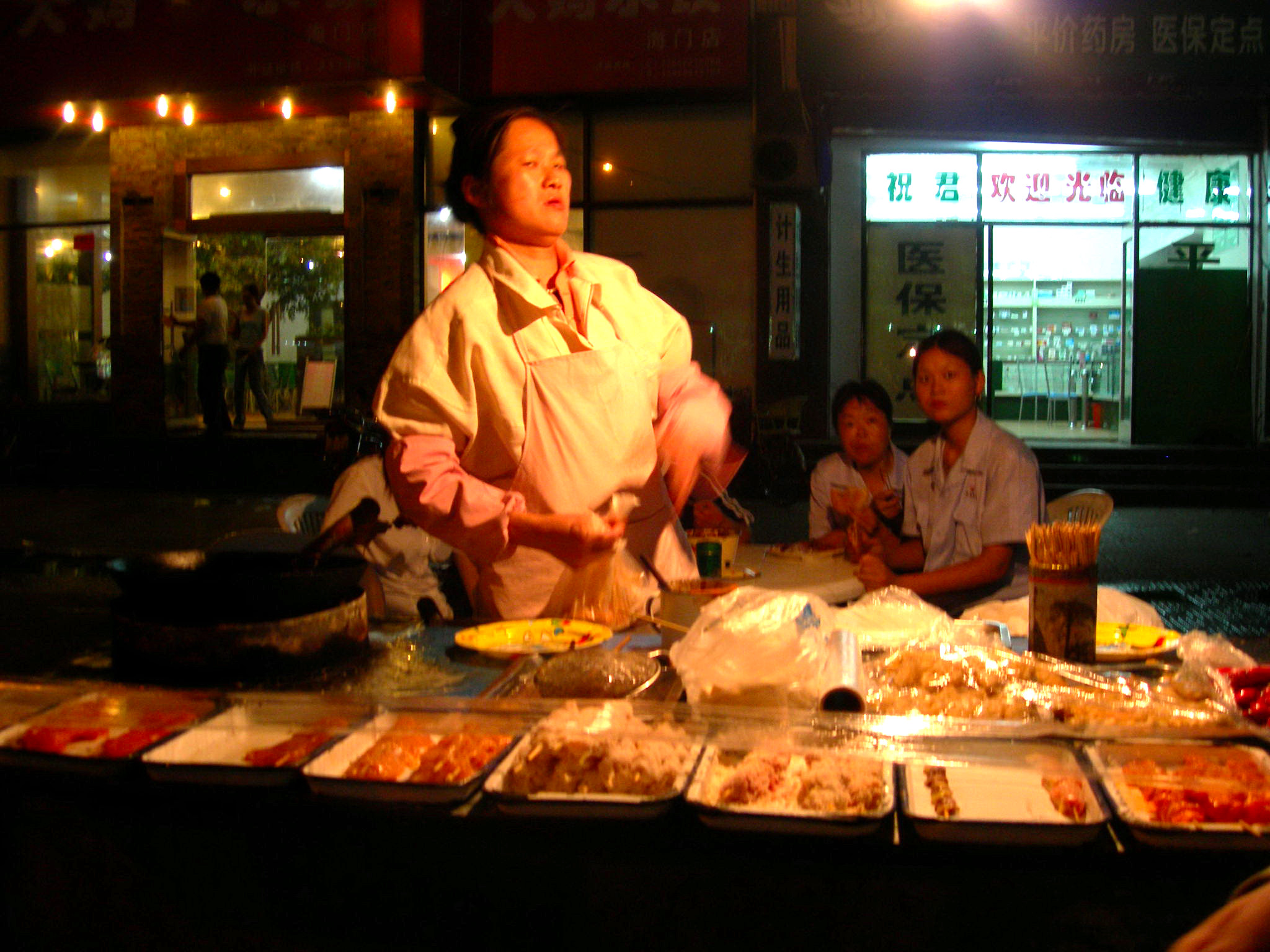
the smiles/ of small girls/ deny what is written/ that no one is glad/ when a girl is born

The reference is to a poem by Fu Hsüan, who died c. 278 AD) called by different translators Woman or Half of China. The actual words in the poem are: No one is glad when a girl is born.  I also thought how it can be the same in China today; there are so many unwanted girl babies. But those who had little girls seemed to cherish them.China 167

outside noodle shops/ in shadowed lanes/ old men dream/ of when a hundred emotions/ stirred their veins

This tanka refers to ‘to the tune of Glittering Sword Hilts’, a poem by Liu Yu Hsi (772 – 846).  The last two lines of the original are: And a hundred emotions/ Rushed through their veins.

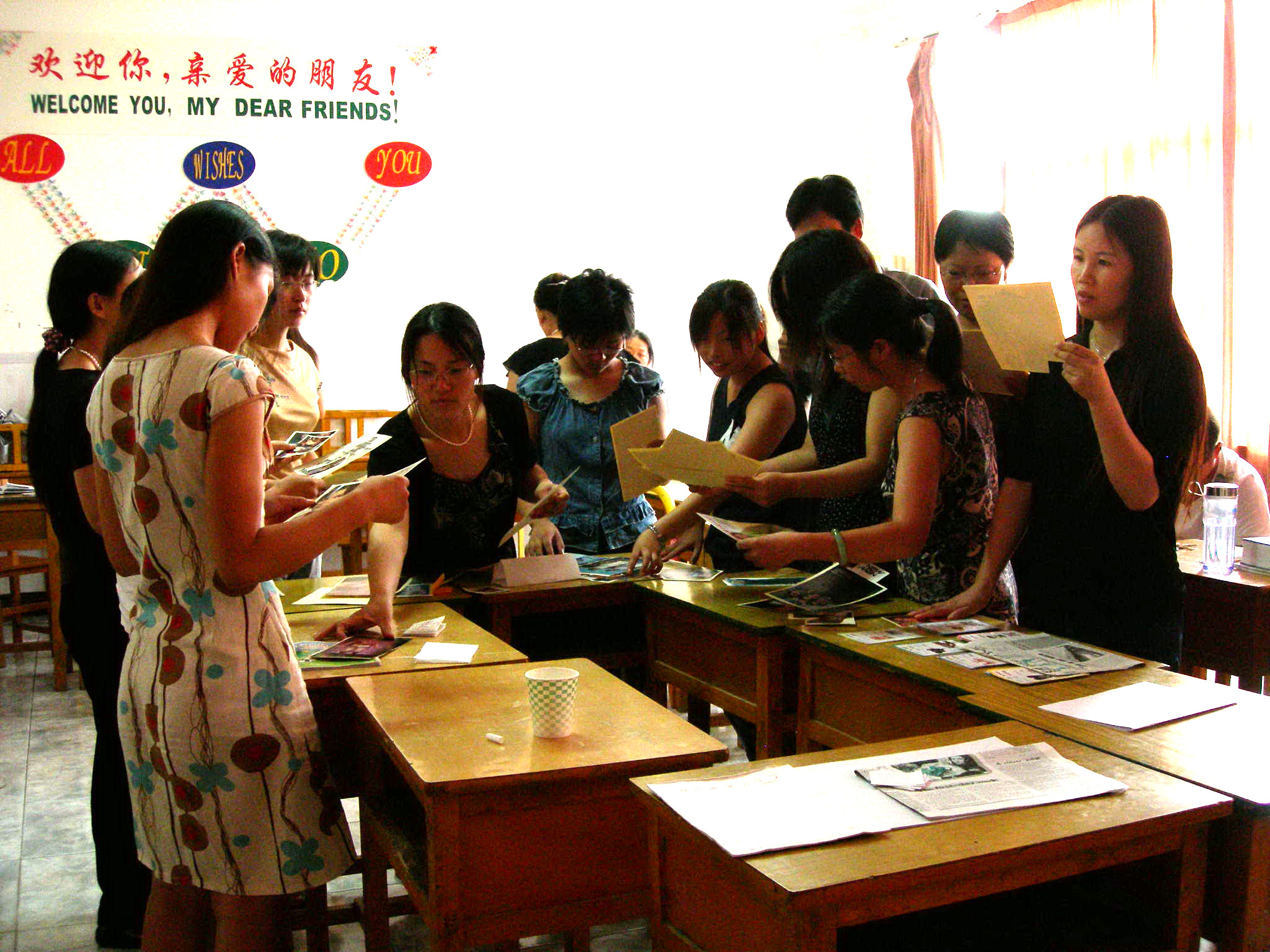
Terry Ann Carter and I were teaching Chinese secondary school teachers new English methods. This was written about a young teacher with glorious hair:

the young teacher/ has untied her hair/ it falls over her shoulder/ glossy as a cicada’s wing/ iridescent as a blackbird’s wing

China 209

It made me think of Meng Haoran’s poem (691 – 740 AD) about a woman loosening her hair, that had the lines My hair loosened, I enjoy the coolness of the evening.

Not all the Chinese poems I used are ancient. In writing the following, I was thinking of a poem by Wen I-To (1899 – 1946), Wonder:China 331

in the shaded pavilion/ we wait for our young friend/ she steps through the moon door/ wearing/ a circle of light.

China 327And a last one:

noon at the mattress store/ as if she will dream until dawn/ on an incense pillow/ the clerk/ sleeps at her desk

refers to a poem by Po Chü-I (772 – 846) called A Song of the Palace.

This was a great way for me to do two or three things at once―read Chinese poetry, journal about the trip, and think about the ongoingness of Chinese history.

Writer/ Editor Hat

Here is a photo of Leonard Budgell at eighteen. He has just been officially hired by The Hudson`s Bay Company at Cartwright, Labrador. Son of a Hudson`s Bay Post Manager, unofficially he had been behind the counter in Northwest River and Rigolet since he was about ten.

len at 18Len was extremely shy and several of his letters tell of experiences when he was behind that counter that would have him blushing furiously. Usually a young nurse would be involved, asking the boy for something like a pair of longjohns. At other times he drove nurses and doctors by dogsled around to the tiny Labrador communities. A storm would arise, and shelter found in a tiny trapper`s tilt. The nurse of course, not properly dressed for Labrador storms, would be wet and cold, and Len would be caught. Once her clothes were off and drying, what to do…

Len would go on to be a Servant of The Bay (his favourite term) for many years in Northern areas. Where many men might remember, and tell or write of these experiences, Len just happened to be an incredible writer. His stories have us laughing or crying, connecting, learning or laughing. Want to read some wonderful things about the sea, or animals of the North, or the natural abilities of native peoples, or whales or seals, or owl eggs, go to Arctic Twilight: Leonard Budgell and the Changing North (2010, Blue Butterfly Books-Dundurn Press).

In The Globe, Michael Crummy called Len  the greatest writer on the North that he knows of. Mr. Crummy credits Len`s writing about boats and engines in his own novel, Sweetland.

I miss him very much. Leonard died in the year 2000, but his words will be here for a very long time. For more about Len and Arctic Twilight, you can to the Archives, and the June posts.


Tree Press Publisher hat

There is a Tree/shteyt a boim: Poems by Itzik  Manger translated from the Yiddish by Murray Citron (Tree Press, 2011)  See, already this sounds interesting, and very different!cover a tree murray


(Contact me on facebook for copies and I`ll put you in touch with Murray)

When Rod Pederson, Rona Shaffran and I were co-directors of The Tree Reading Series, we decided to form Tree Press. We had big plans for the Press, mainly to hold an annual Chapbook Contest, but we wanted to start off with a special publication. Our choice was to publish Murray Citron`s translations. We had been hearing the poems at the open mic.

Itzik Manger was born in Rumania about 1900. In 1938 he moved to Paris, and in 1940 he escaped just ahead of the Germans. This is only part of his story.

Murray Citron has a BA from the University of Toronto, Osgoode Hall, but he always begins by saying he is a grandfather. This is only part of his story.

This was a tricky book to do. Murray would find a Yiddish version of a poem, like this one, which of course, I could not read…yiddish poem

At this moment, I have no idea which poem this is, and in matching the Yiddish and English translation, there were a few glitches. My parrot for one, was not happy with the time I was spending with Murray, and made quite a scene. Eventually we got it all straightened out, the right Yiddish with the right English versions.

Here is one of the translations, most likely not a match for the poem above; the poems are based on biblical stories, but are full of surprises and humour:

 Abraham and Sarah

 “Abraham, when will we have a child?

We are both long past our prime.

In other families a woman my age

Is due for the eighteenth time.”


Abraham our Father smiles and is still

And puffs a ring from his pipe.

“Have faith, my wife.  If the Supreme One wishes,

Then even a broom can be ripe.”


“Abraham, listen, every night

My body cuts like a knife.

Hagar is only your serving maid,

But I am the one who’s your wife.


Sometimes in the window I see a star,

And I think it is the soul

Of our child who flutters in the wind

Where clouds and waters roll.”


Abraham our Father puffs his pipe.

The smoke is warm and good.

“Have faith, my wife.  If the All-highest wills,

Even a broom can shoot.”


“When I see sometimes how Hagar’s child

Plays in the sun and the sand

And I give a pat on his little head,

Such a sadness grabs my hand,


And when I hold him on my lap

And he smiles so clever and good,

My eyes grow wet and dim with tears,

And sorrow dulls my blood.


Sweetheart, when will we have a child?

We are both long past our prime.

Among other people a woman my age

Has been due for the eighteenth time.”


Father Abraham puffs his pipe,

The smoke is warm and good.

“Have faith, my darling.  If the All-highest wills,

Even a broom can shoot.”

It was such a privilege to work with Murray on this. I`m so glad we three co-directors were so clever in choosing these translations as our inaugural Tree Chapbook.


Your Hands

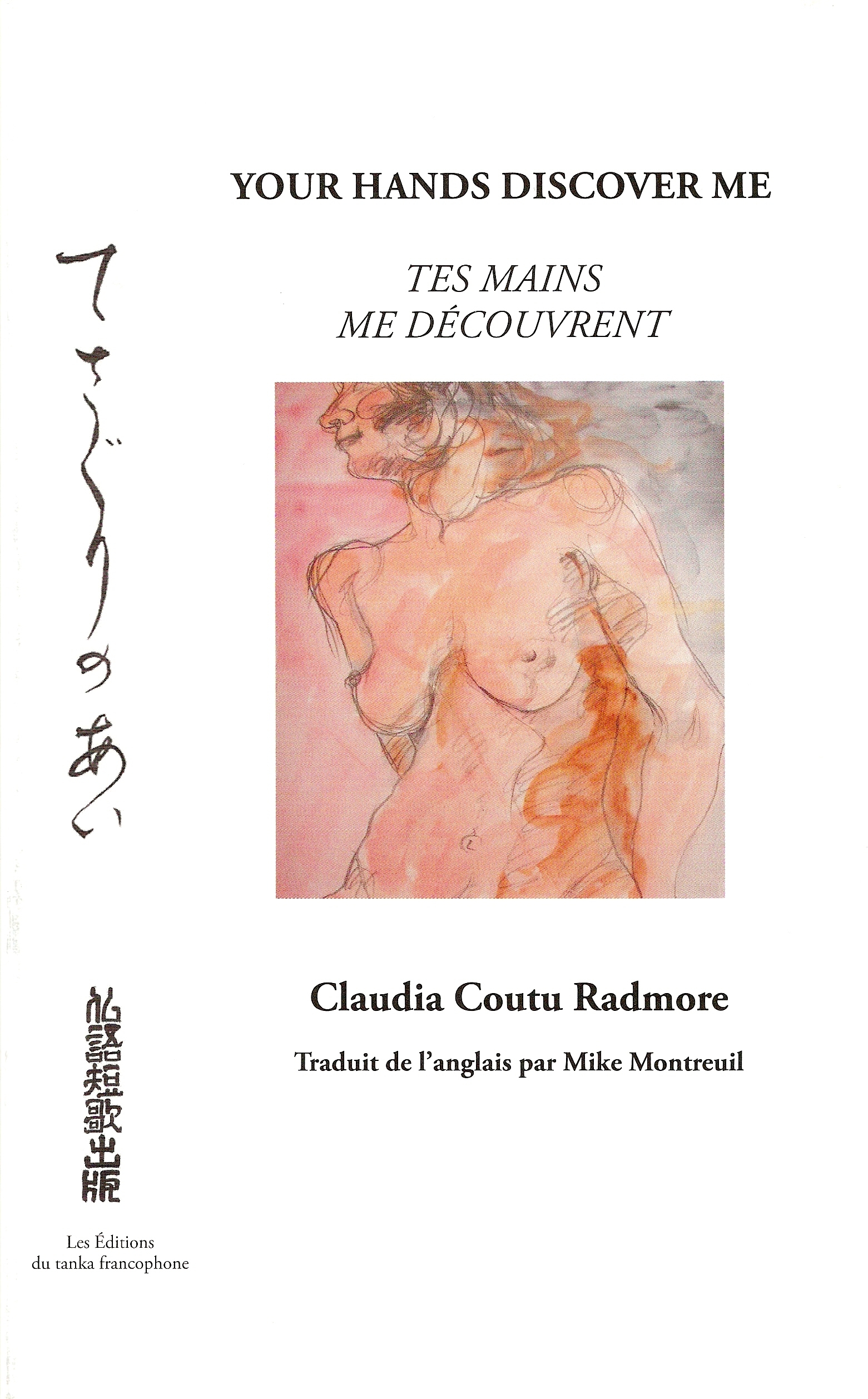
Your Hands Discover Me/ Tes mains me découvrent, Claudia Coutu Radmore translated by Mike Montreuil (2010, Les Éditions du tanka francophone, Montreal)  scan0001Tanka written about a love affair between two poets, one who lived in Canada and one in Massachusetts. I was fortunate that Mike Montreuil was available to translate this manuscript; it was a pleasure to get together to thrash out the final version, and he is excellent at this kind of translation, soul of poet to soul of poet.  While I am not bilingual, I have read a fair amount in my father’s tongue, and could understand the nuance of a translation. (My Mother was English so that was what we spoke at home.)

These are from a series of tanka written in the heat of passion. No need to say much more…

ditches/lined with fireweed/ after so many miles/ flames/ that won’t go out

                  des fossés/ garnis de bouquets rouges/ après tant de kilomètres/ des flames/ qui ne                     s’éteindront jamais

I am honoured that Michael Dylan Welch, Founder of The Tanka Society of America wrote an introduction that he named ‘Alive and Urgent’. Thank you Michael!

Publisher’s Hat, Renku

Petals in the Dark, 15 renku led and edited by Marshall Hryciuk (catkin press, 2015)er only

A delicious collection of renku, renku verses and contributions from poets all over the world. Marshall Hryciuk is a Canadian renku master and we love to brag about him, claim him as our own.

Marshall has continued the Japanese tradition of ‘writing blind’ as art. In an introduction, he talks about renku in a innovative style, asking, rhetorically “Why Renku?”

And what IS renku.  Think of it this way to start: A short verse is given and you as participant are asked to contribute the next verse. This may result in each participant offering a verse, from which the master will choose the most appropriate. He/She will have suggested guidelines for the verse, and your contribution will link to the previous verse, yet shift away from it. In this way, the series is always full of surprise for participant and reader.

Example: Say the verse offered mentions water. This is the time to bring to mind anything water means to you. The link can be direct, or subtle. Water may make you think of mist, river, rain, tears, its chemical composition, bottled water, washing, sweat, flooding, colourless, flowing, or a thousand other things. It may suggest a mood, you may think of its opposite, a word like desert. You may think of a connection with a written work or a myth. You may think of a song, or a movie.

The master will suggest that the next verse also be about something, such as a blossom or a moon verse, or about media, or unrequited love. Then your water connection becomes more focused. Unrequited love, and water. Cry me a River?

Here are two renku verses:

i’m wondering
where i parked my bicycle
is that a purple bra strap? (written by Marshall Hryciuk)

cats in love
waiting for the stars to come out (link made by Karen Sohne)

The ‘instructions for Marshall’s verse were probably “three lines, romance”, or something in that vein. Karen follows with the ‘yearning’ of cats waiting for darkness so they can do what cats do in the dark. She has shifted from a day scene to an evening one, and away from daily concerns to that of evening possibilities. At the same time, the responding verse leaves open a number of possibilities: new links can be made with the animal world, with what exists in the universe, even into interior universes. Or a link can be associated with waiting, or conversely, with arrival.

Part of the fun of renku is that it is meant to be a party. Bring on the saki after the six verse, or the beer and popcorn. Anyone, with or without experience in the form, can participate.

This book is a collection of ideas and poems that showcases wit, intelligence, sensibility, pathos and humour. In connecting emotion, memory, and experience, renku dwells on the fullness of being in every moment of our lives.

One Sunday in Winter

One Sunday in winter Mike Montreuil and I went to a performance by The Griffin Trio of Johannes Brahms’ Piano Trio in B Major, Op. 8. That experience prompted this series of tanka: cover AugmentationAugmentation on a Sunday in Winter  (catkin press, 2014)
Throughout the performance one of the performers gave a running commentary of how the piece worked, which fascinated me. At home, I had come across Pablo Neruda’s poem, “Sonata With Some Pines”, and thought to include Neruda in this Sunday conversation. The last line of this first tanka is from his poem:

a change in the last note/ then down a scale/ down again then/ leap up/ we forget our tired bones

Two more poems from that day:

the key to organic flow/ going back/ to what has come before/ a gentle explosion/ a surprising intimacy

a different mood/ cello’s third set/ of mounting notes/ conversation among crows/ at the top of the pine

It’s a small book, about 4″ by 5″, with a translucent cover, and 18 poems, a chapbook that makes me smile about that afternoon whenever I happen to see it.

Back to poetry and history

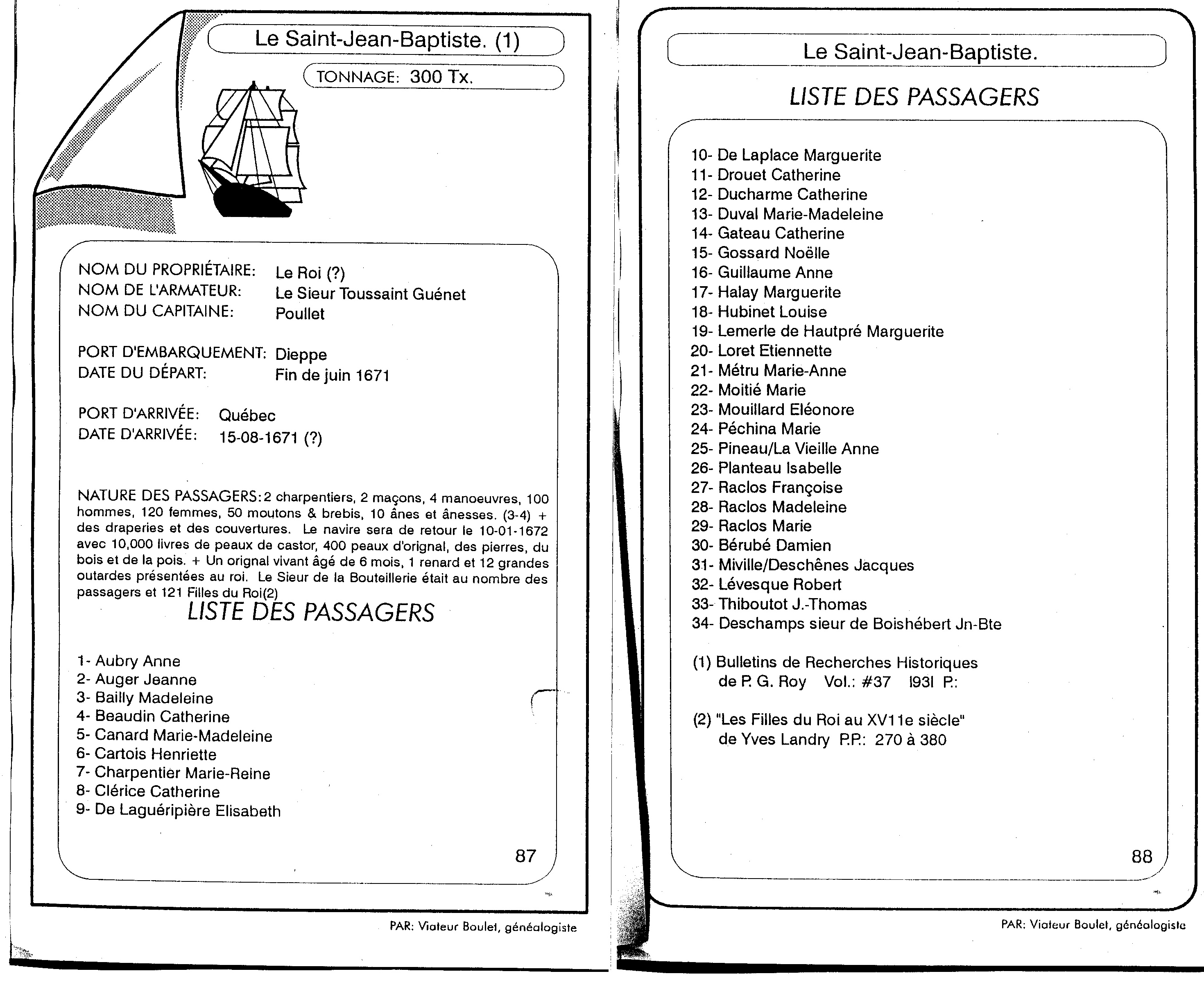
Should anyone wonder why I know for sure that my seventh great grandmother came to New France on a ship called the Saint-Jean-Baptiste out of Dieppe in 1671, here’s a record of the ship and some of its passengers.ship013Margeurite De Laplace is # 10 on the list, a fille du Roi, along with 2 carpenters, 2 masons, and 100 men 50 sheep… Also listed are ten donkeys.

The record also mentions that the ship returned to France in October with 10,000 pounds of beaver skins, 400 pounds of moose skins, 12 geese and a fox as gifts to King Louis XIV.

In the first poem in a minute or two/ without remembering, twelve year old Margeurite, orphan, speaks from on board ship. She was from the La Salpêtrière, at that time an orphanage/hospital in Paris.

She and Pierre LeSiege’s eldest daughter Louise would marry François Cottu (Coutu). She and François would become my sixth great grandparents and start the Coutu family and the Coutu name in Quebec and all over the world.


More Publisher’s Hat

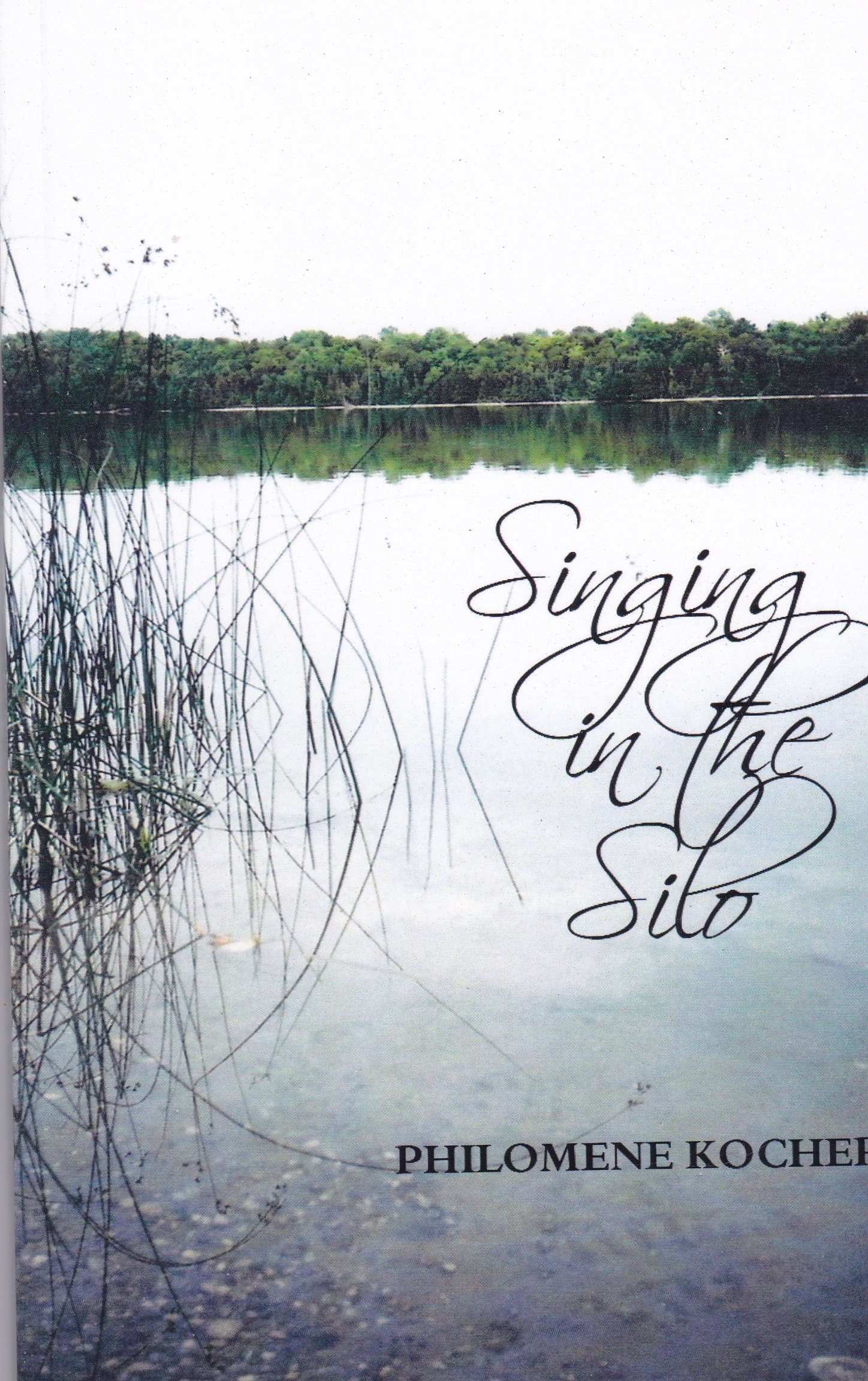
Singing in the Silo by Philomene Kocher (2014, catkin press)

singing in the silo coverAt the end of this post, note the website of Philomene Kocher, for that is where you can get a copy of this gem.

When a writer with a haiku heart lets you in on her process, it is a special gift to the haiku/tanka/haibun world. This is what Philomene Kocher has done. Instead of selecting ‘only her best’ work, she shows her first haiku, and lets you follow her growth in writing Japanese form.

Ms. Kocher grew up on a farm in Ontario, and many of her haiku reflect this, and speak of family joys and sadness:

boots phil 1In a haibun (prose followed by haiku) this is the haiku she uses, an early memory:

U turn/ the snake slides/ over its own tail

After a death, she writes:

over the years/ the wound on the elm/ has closed and healed/ like the one in my heart

There is a tender world between the covers of Singing in the Silo, between her photo on the front cover of a lake dear to her and her sisters, and the image of the farm family’s boots on the back.

http://www.singinginthesilo.ca/